Why do some tides rise five storeys high while others barely move?
One bay in Canada can swing 17 metres between low and high tide, while out in the North Sea there are spots where the tide doesn't rise or fall at all.
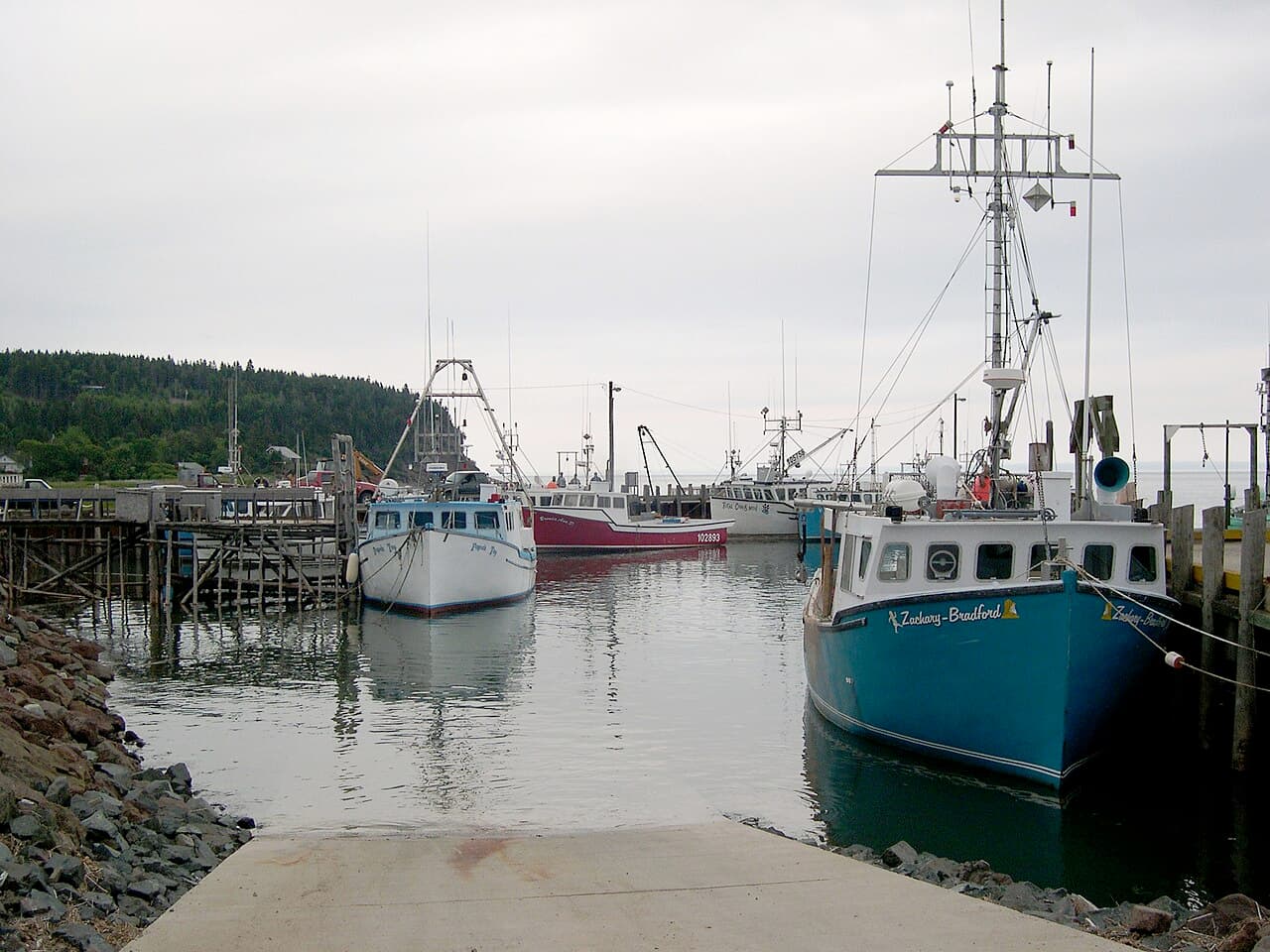
▶ Start the storyBecause the Moon and Sun only set the beat; ocean basins and coastlines decide how big the swing gets. Tides are the periodic rise and fall of sea level caused mainly by the differential pull of the Moon and Sun, but in an idealized ocean of uniform depth with no land, the Moon's tide would reach only about 54 centimetres at its highest. Real tides are strongly modified by the geometry of ocean basins, continental boundaries, the shape of the seafloor, the Coriolis effect, friction in shallow seas and the resonance of coastlines. In Canada's Bay of Fundy, the result is a range measured at 16.3 metres in 1998, with a predicted extreme of 17 metres: about five storeys.
At the other extreme are places where the tide doesn't move at all. In an ocean basin, the lines joining places that have high water at the same moment wheel around a central spot called an amphidromic point, where there is zero tidal motion, and tides generally weaken moving away from the coasts toward it. William Whewell, trying to make his tide maps consistent, guessed that such a spot must exist in mid-ocean; in 1840 Captain William Hewett confirmed one with careful soundings in the North Sea.
The astronomical beat also changes through the month. Around new and full moon, when the Sun, Moon and Earth line up, the Sun's pull reinforces the Moon's and the range peaks in a spring tide; about a week later, at the quarter moons, the Sun partly cancels the Moon and the range shrinks to a neap tide.
The Bay of Fundy is often said to have the world's highest tides because of its shape, the depth of its seafloor and its distance from the edge of the continental shelf. Such huge swings are also an energy source, though only a few tidal power plants exist, the most famous being La Rance in France.
Quiz me
0/3
Recap
The Moon sets the beat of the tides; the shape of the ocean decides how high they go.
Surprising fact · In an ideal ocean with no land, the Moon's tide would only reach about 54 centimetres.
Connects to
Sources (1)
No source, no claim. Every fact in this lesson (15 claims) cites at least one of these.