Why do hurricanes spin opposite ways in the two hemispheres?
Your sink doesn't drain the other way in Australia, but hurricanes really do spin the other way, and World War I gunners had to aim for it.
▶ Start the storyHurricanes spin anticlockwise north of the equator and clockwise south of it because the Earth is turning underneath the moving air. Seen from the rotating ground, anything that travels a long way seems to be pushed sideways: to the right in the Northern Hemisphere, to the left in the Southern. That apparent push is the Coriolis effect. When a low-pressure area forms, air rushes in towards it from all sides, but every stream is deflected, so instead of flowing straight to the centre the air wheels around it. In the north that gives an anticlockwise spin, in the south a clockwise one: a mirror image.
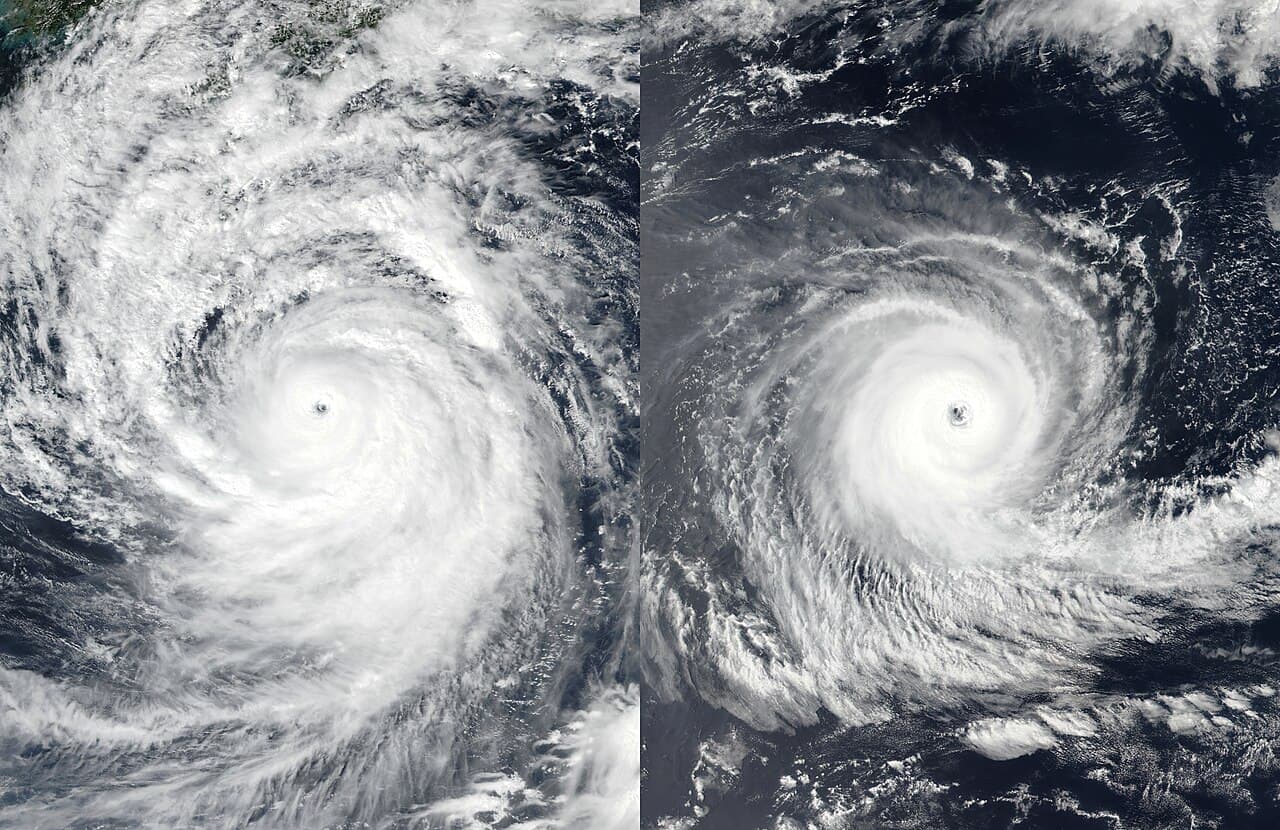
The effect is strongest near the poles and fades to zero at the equator, which is why cyclones rarely form right along the equator. It is also tiny for small, quick motions. It only shows up over large distances and long times, such as winds and ocean currents, or when precision matters, as in long-range artillery.
That is why a famous myth is wrong: sinks and toilets do not drain in opposite directions in the two hemispheres. The shape of the drain and the water's leftover swirl are far stronger. It took a heroic effort to catch the effect in a basin: in 1962, Ascher Shapiro at MIT let a 2-metre tank of water settle for at least 24 hours before pulling the plug, and saw it drain counterclockwise every time.
Gunners met the effect for real. In World War I, Germany's Paris gun fired shells from about 120 kilometres away; they climbed 40 kilometres high, so its crews had to take the Earth's rotation into account.
Quiz me
0/3
Recap
Big and slow, the Coriolis effect rules; small and fast, it vanishes, and at the equator it fades to zero.
Surprising fact · Sinks don't drain the opposite way in Australia: at that scale the drain's shape matters far more than the Earth's spin.
Sources (5)
No source, no claim. Every fact in this lesson (22 claims) cites at least one of these.