Why would anyone put solar panels in space instead of on Earth?
A satellite in the right orbit can sit in full sunlight 99 percent of the time, while a rooftop panel on Earth collects power for less than a third of the day.
▶ Start the storyA solar panel on an Earth rooftop only works part of the day: it's dark at night, and clouds, dust and the atmosphere dim the light. A solar panel in the right orbit around Earth doesn't have those problems. Space-based solar power is the idea of collecting sunlight with satellites and beaming the energy down to Earth, usually as microwaves, to be picked up by a ground antenna.
In orbit, it's effectively always solar noon, and there's no atmosphere, cloud or dust in the way, so sunlight there can be about 44 percent more intense than the strongest sunlight reaching Earth's surface. A well-placed satellite can stay lit over 99 percent of the time, falling into Earth's shadow for at most about 72 minutes a night around the equinoxes. Compare that to ground panels, which on average only collect power for about 29 percent of the day.
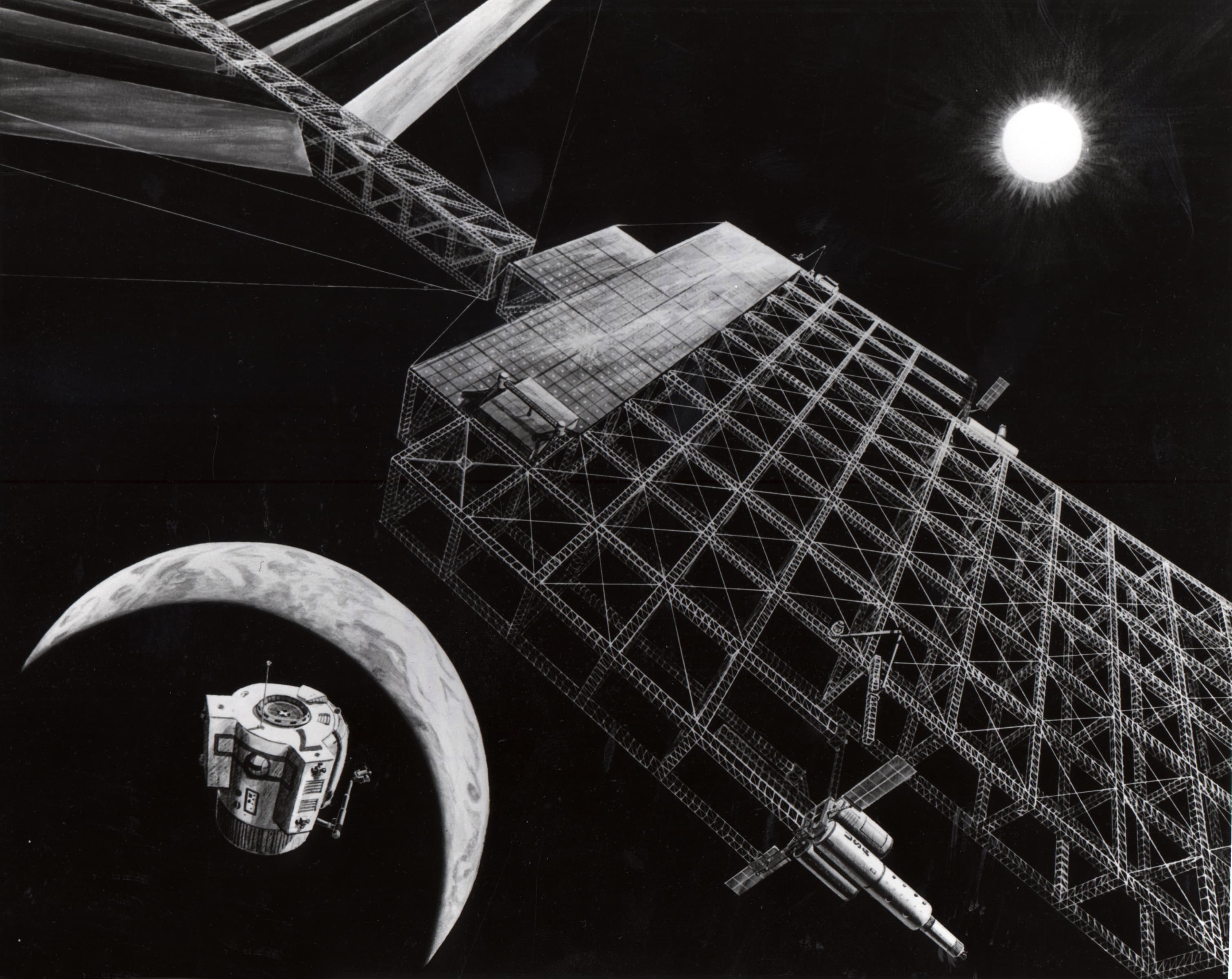
The concept isn't new: it was first described in 1968, Peter Glaser patented a way to beam the power down in 1973, and the U.S. government ran a $50 million feasibility study on it in the late 1970s and 1980s. More recently, Caltech's small test system MAPLE, successfully beamed power from orbit down to Earth in 2023, even though the amount it sent, a few watts, was tiny next to what a real power satellite would need.
The catch is doing it at a useful scale. Launching the satellites is expensive, building and repairing them in orbit is mostly a job for robots because radiation makes it too dangerous for astronauts, and a ground station big enough to usefully catch the beamed power would itself cost roughly a billion dollars for 5 gigawatts, by one researcher's estimate.
Quiz me
0/3
Recap
Orbiting solar panels can be lit almost 24 hours a day, but launching, maintaining, aiming the power beam, and building a giant ground antenna remain the big unsolved engineering problems.
Surprising fact · Caltech's MAPLE demonstrator beamed real power from orbit to Earth in 2023, even though the amount received on the ground was less than a tenth of a microwatt.
Sources (1)
No source, no claim. Every fact in this lesson (14 claims) cites at least one of these.