Why do spacecraft have to slow down to catch up?
In 1965 an astronaut tried to fly up to a rocket stage a few hundred metres away. Every time he pushed toward it, it slipped further off.
▶ Start the storyBecause in orbit, speed and height are chained together. Fire your engine forward and you don't simply go faster: you climb into a higher orbit, and higher orbits are slower and take longer to go round. So a spacecraft that chases a target by pointing at it and thrusting rises above it, falls behind and drifts away. The trick is the opposite of driving: drop into a slightly lower orbit, which is faster, let the gap close, then climb back up.
It helps to remember what an orbit is. Newton imagined a cannon on a high mountain. Fire the ball slowly and it falls back to Earth; fire it at orbital speed and it keeps circling the planet and comes back round to the mountain. A satellite is always falling toward Earth, but it moves sideways so fast, about 7.8 kilometres per second in low orbit, that the curved ground keeps dropping away beneath it. Astronauts float not because gravity has vanished but because they and their ship are falling together.
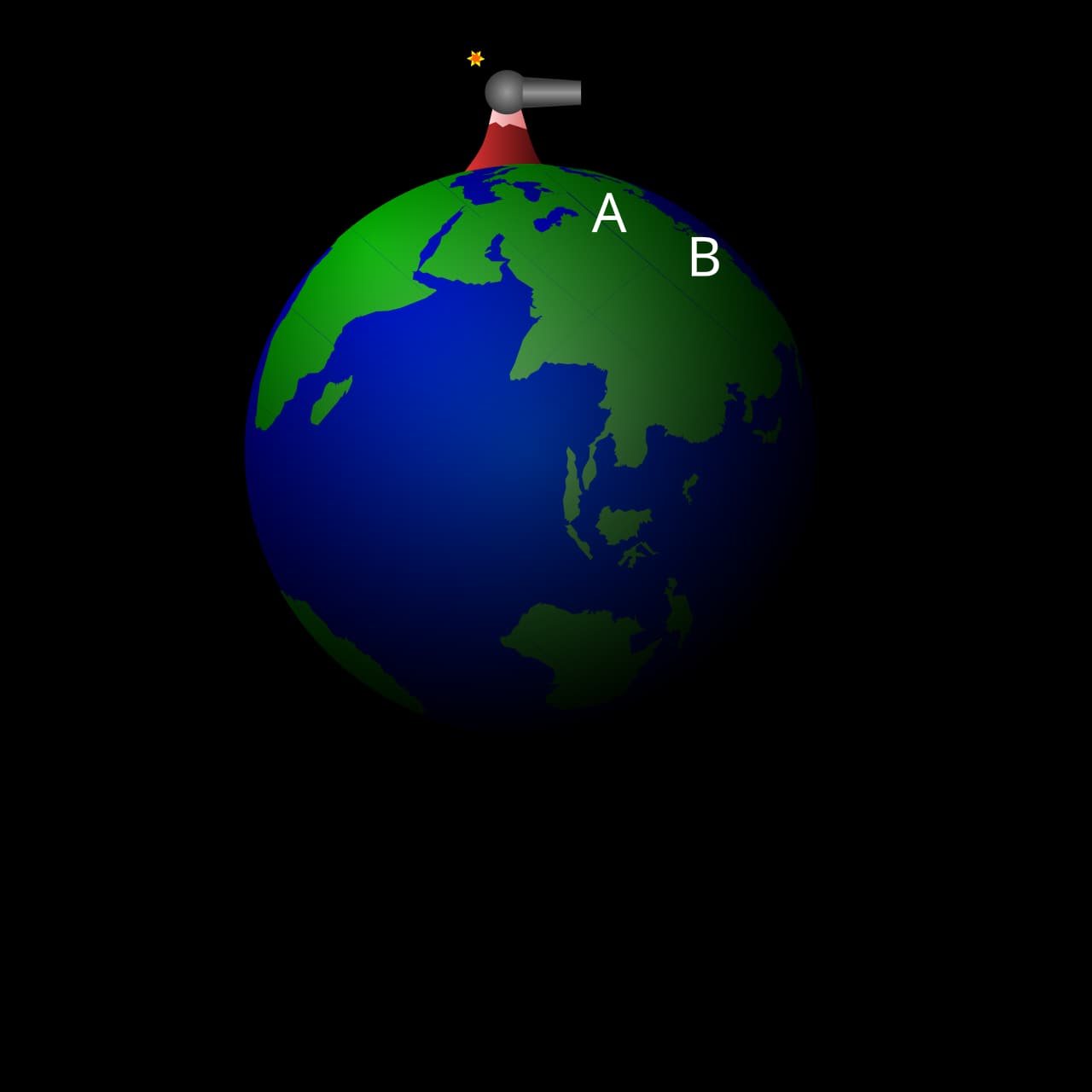
The closer you are, the harder gravity pulls and the faster you must go: a circular orbit at 200 km moves at 7.79 km/s, one at 1,500 km at only 7.12 km/s. And by Kepler's third law, a bigger orbit takes disproportionately longer to complete.
NASA learned all this the hard way. On 3 June 1965, Jim McDivitt tried to steer Gemini 4 up to the spent upper stage of his own rocket. Thrusting straight at it kept changing his orbit, and at one point his braking thrust dropped him lower and faster, so he slid away and downward. After burning almost half his thruster fuel, he gave up. Six months later, with burns planned around orbital mechanics, Wally Schirra brought Gemini 6 within 30 centimetres of Gemini 7.
Step 1: Drop slightly lower
A lower orbit is faster, so the chaser gains on every lap.
Step 2: Close the gap over several orbits
Precisely timed burns, often over hours or days.
Step 3: Climb to the target's orbit
Arrive at the same height, matching speed.
Step 4: Station-keeping, then docking
No relative motion left between the two craft.
Quiz me
0/3
Recap
To catch something ahead of you in orbit, drop lower to go faster, then climb back: pushing straight at it lifts you into a slower orbit.
Surprising fact · Kepler discovered his third law of orbits while trying to write down the music of the spheres, and expressed it in musical notation.
Sources (9)
No source, no claim. Every fact in this lesson (30 claims) cites at least one of these.