Why can't we ever see the other side of the Moon?
Nobody had ever seen the far side of the Moon until 1959. Earth's gravity had put the brakes on its spin.
▶ Start the storyWe always see the same face of the Moon because it spins exactly once for every trip around Earth. Its day and its month are the same length, so as it circles us it turns just enough to keep one side pointed our way. Astronomers call this tidal locking, and Earth's gravity is what set it up.
Earth pulls harder on the near side of the Moon than on the far side. That uneven pull stretched the Moon slightly along the line pointing at us, raising two bulges. Long ago the young Moon spun faster, and its rotation kept dragging those bulges slightly out of line with Earth. Earth's gravity tugged on the misplaced bulges and acted like a brake. Over millions of years the spin slowed, its energy lost as heat, until one rotation matched one orbit and the braking stopped.
For all of human history, that left half the Moon a mystery. The far side is sometimes called the dark side, but it gets as much sunlight as ours: dark only meant unseen. About 82 percent of it stayed hidden until 1959, when the Soviet probe Luna 3 sent back the first photographs. In December 1968 the Apollo 8 crew became the first people to see it with their own eyes, and in 2019 China's Chang'e 4 made the first landing there.
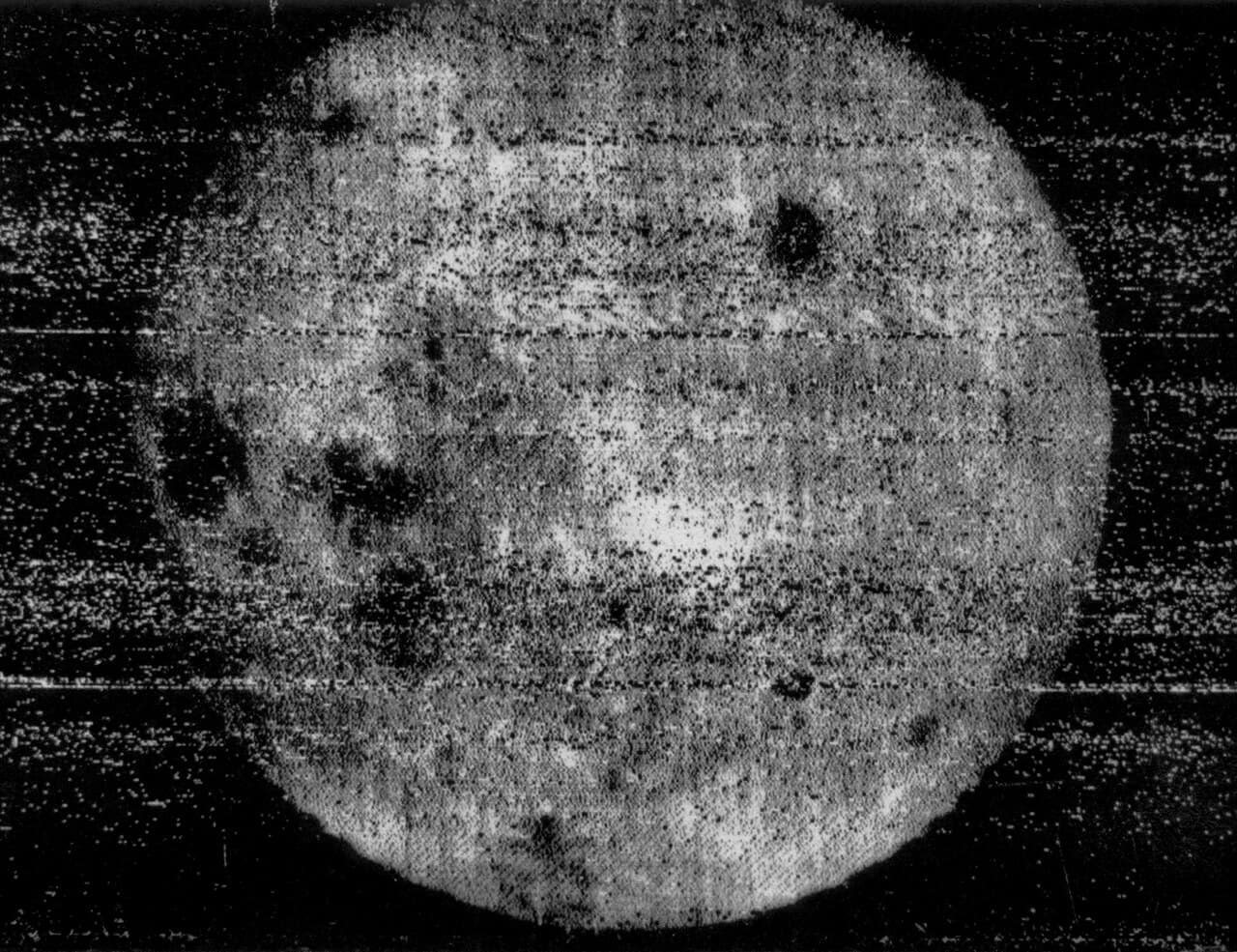
Even from Earth, the lock isn't perfect. Slight wobbles and shifts in viewing angle let us peek around the edges, so over time we can see about 59 percent of the Moon's surface.
Quiz me
0/3
Recap
Gravity pulls unequally across an orbiting body to form bulges, and dragging those bulges out of alignment creates a braking torque that locks its spin.
Surprising fact · The far side stayed unseen until Luna 3 photographed it in 1959, and it is not dark at all: it gets two weeks of sunlight at a time.
Sources (3)
No source, no claim. Every fact in this lesson (15 claims) cites at least one of these.