Why is a month longer than the Moon's actual trip around the Earth?
The Moon completes one full orbit in about 27 days. So why does it take almost 30 for the Moon to go from full to full again?
▶ Start the storyThe Moon actually completes one full lap around Earth, relative to the distant stars, in about 27 and a third days — astronomers call this a sidereal month. Yet the 'month' most lunar calendars actually track, the time from one full moon to the next, runs about 2.2 days longer, averaging 29.53 days. The gap exists because Earth itself isn't standing still while the Moon circles it: Earth keeps moving along its own orbit around the Sun, so after the Moon has gone all the way around once relative to the stars, it still hasn't quite lined back up with the Sun and Earth the way it was before. It has to travel a bit further to catch up to that same Sun-Earth-Moon alignment, which is what actually produces the full set of lunar phases.
That longer, phase-based cycle is called the synodic month, and it's the one most cultures have built calendars around, since it's what anyone can see just by watching the sky. Because Earth's orbit around the Sun is elliptical, its speed varies over the year, and the Moon's speed around Earth varies even more, which means the real gap between one full moon and the next isn't fixed either: it can run anywhere from about 29.27 to 29.83 days, even though the long-run average lands very close to 29.53.
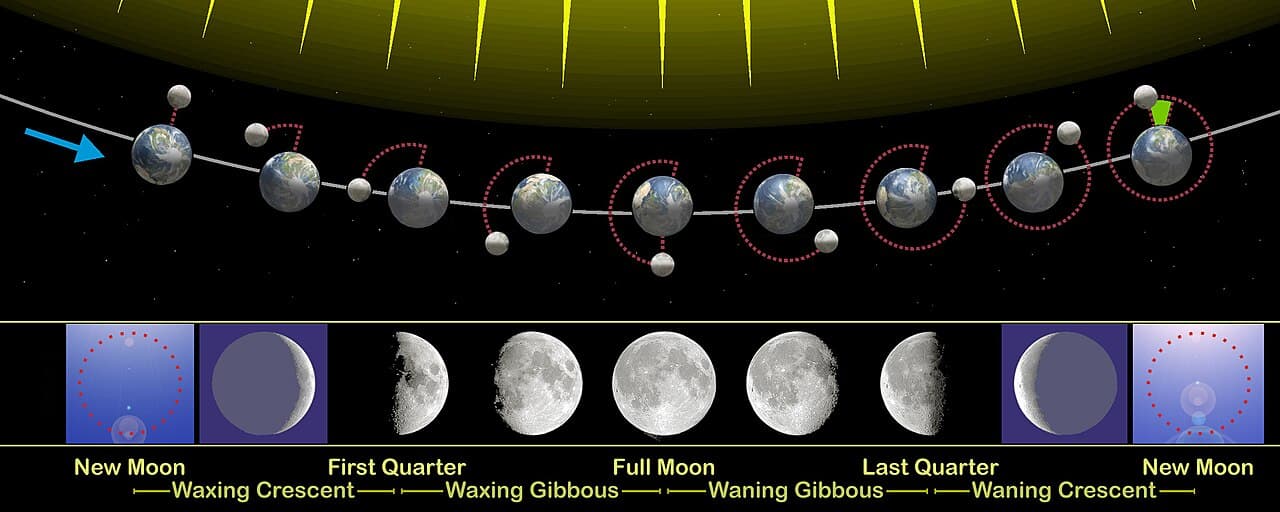
Most of the ways people have sliced up the lunar month, aside from the fine distinction between the sidereal month and a closely related tropical month, trace back to Babylonian astronomers. Cultures in the Middle East, India and China, meanwhile, divided the sky into 27 or 28 "lunar mansions," one for each day of the sidereal month, each identified by its prominent stars: a named patch of sky for every day of the Moon's trip.
Quiz me
0/3
Recap
A month looks longer than the Moon's orbit because Earth keeps moving around the Sun while the Moon circles it, so the Moon needs extra time to catch up to the same Sun-Earth-Moon alignment.
Surprising fact · Because Earth and the Moon speed up and slow down along their elliptical orbits, the real gap between lunations ranges over more than half a day.
Sources (1)
No source, no claim. Every fact in this lesson (10 claims) cites at least one of these.