Why can't you know exactly where a particle is and how fast it's moving?
It isn't that our instruments are too clumsy. Nature itself refuses to let a particle have a perfectly sharp position and a perfectly sharp speed at the same moment.
▶ Start the storyYou can't know exactly where a particle is and how fast it's moving because nature won't let both be sharp at once. It isn't that our rulers and stopwatches are too clumsy. The more precisely a particle's position is pinned down, the less precisely its momentum (its speed and direction) can be known, and the reverse. This is the uncertainty principle, and better equipment never beats it.
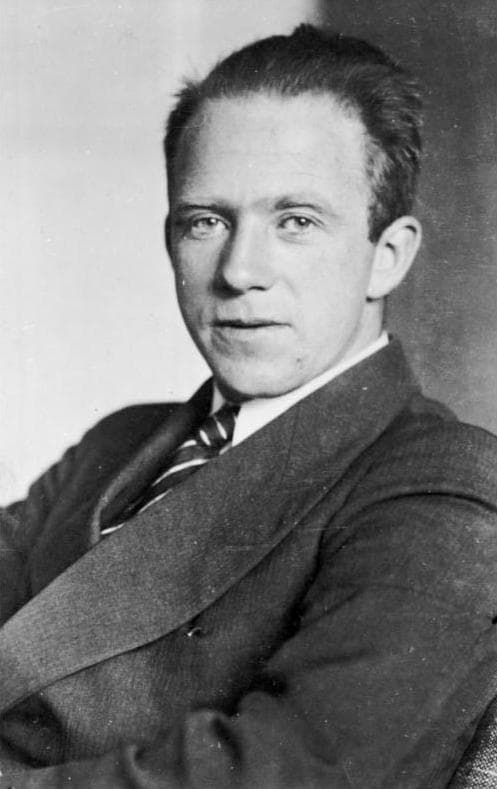
Werner Heisenberg found it in Copenhagen in 1927. It grew out of a breakthrough two years earlier. Worn down by months of fruitless research and a brutal hay fever, he fled to the pollen-free island of Heligoland in the summer of 1925. There he conceived the basis of quantum mechanics. He won the 1932 Nobel Prize in Physics for creating it.
The deepest version of the principle isn't about disturbing a particle. In quantum mechanics a particle behaves like a wave, and waves have a built-in trade-off. Think of sound. A pure, long note has a precise pitch but no precise moment. A short click has a precise moment but no single pitch. You can't have both, for a sound or for a particle.
Heisenberg's own 1927 argument was framed differently. To see an electron, you must bounce something like a photon off it, which shifts its position or momentum. That disturbance, the observer effect, is real but separate. It also feeds a myth: that a conscious mind is needed to change reality. No research supports that. A detector does the disturbing, whether anyone watches or not. And the effect only matters for very small objects.
Quiz me
0/3
Recap
Pinning down a particle's position more precisely always makes its momentum less certain, the same tradeoff that links a sound's exact timing to its exact pitch.
Surprising fact · Heisenberg laid the foundations of quantum mechanics while recovering from hay fever on the pollen-free island of Heligoland in 1925, two years before the uncertainty principle.
Sources (4)
No source, no claim. Every fact in this lesson (11 claims) cites at least one of these.