How can a single electron go through two slits at once?
Fire electrons one at a time at a wall with two narrow slits. The dots they leave slowly paint stripes, as if each electron had gone through both.
▶ Start the storyA single electron seems to go through both slits because, in quantum physics, it travels like a wave until it is detected. Fire electrons one at a time at a wall with two narrow slits. Each one lands as a single dot. But over time, the dots build up the same striped pattern you get from two overlapping water waves. Each electron behaves as if it had explored both paths.
Thomas Young first ran this kind of experiment with light in 1801, to argue that light is a wave. Light through two slits makes bright and dark bands. They only make sense if waves from each slit add up in some places and cancel in others. Yet light also lands on a screen as separate points, like particles. The stripes only appear once enough points pile up.
In 1924 Louis de Broglie proposed that matter should be a wave too. Clinton Davisson and Lester Germer confirmed it, helped by an accident. They were studying a piece of nickel when air leaked in and spoiled it. Heating the nickel to clean it turned it into a few large crystals. Electrons fired at it now made a diffraction pattern, exactly what a wave would do.
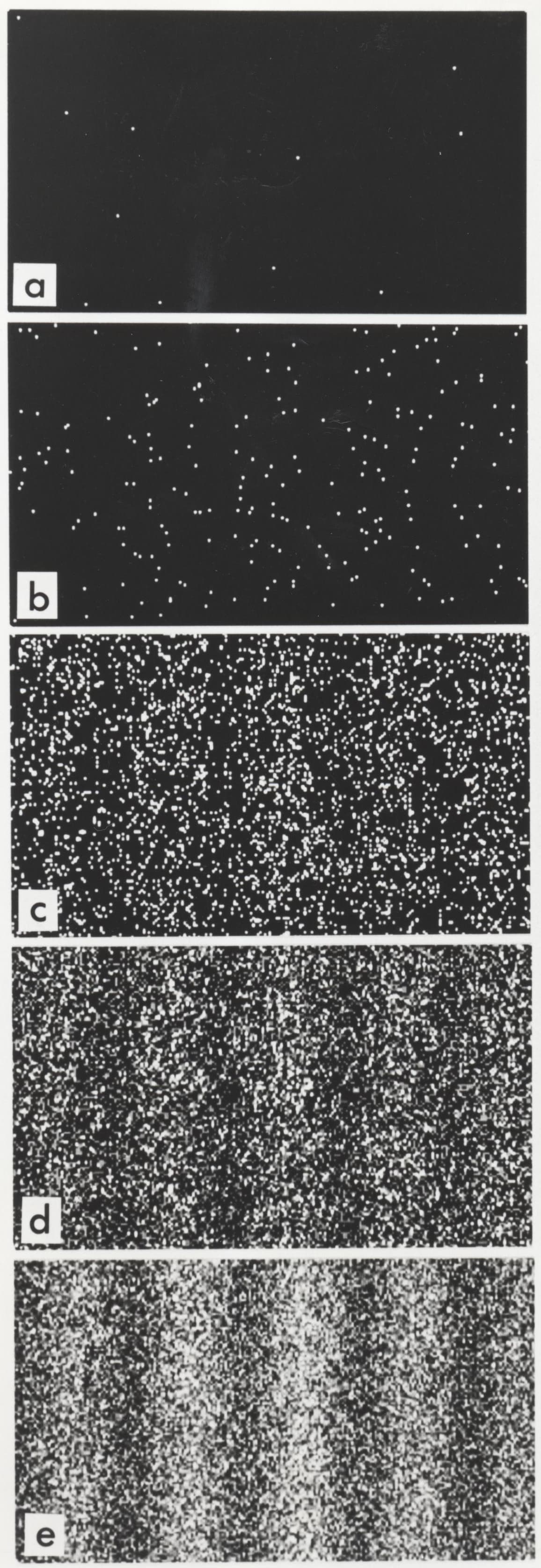
The real surprise came when electrons could be sent one at a time. Merli, Missiroli and Pozzi did it first in 1974, and Akira Tonomura's team published a famous version in 1989. Electron by electron, the stripes still appear. But put a detector at the slits to learn which one each electron used, and the stripes vanish. Richard Feynman called this the only real mystery of quantum mechanics.
Quiz me
0/3
Recap
Each particle lands as a single point, but over many particles the points trace out an interference pattern, unless you watch which slit each one took.
Surprising fact · Davisson and Germer confirmed electrons behave like waves almost by accident, after a vacuum leak and the heating used to fix it turned their nickel into large crystals.
Connects to
Sources (4)
No source, no claim. Every fact in this lesson (13 claims) cites at least one of these.