Why don't electrons crash into the centre of the atom?
Classical physics said a negative electron circling a positive nucleus should spiral straight in and crash within a fraction of a second. Every atom in your body should have collapsed long ago.
▶ Start the storyElectrons don't crash into the nucleus because they can only sit on certain fixed orbits, with nothing allowed in between. Classical physics said the opposite. Any charged particle that accelerates gives off energy, and an electron circling a nucleus is always accelerating. So it should spiral inward and collapse almost at once. Every atom should have crushed itself long ago. Clearly, atoms don't.
The nucleus itself was a surprise. In 1909, Hans Geiger and Ernest Marsden fired alpha particles at thin metal foil, expecting them to sail through. A few bounced almost straight back. Ernest Rutherford later said it was like firing a heavy shell at tissue paper and having it come back at you. The only explanation was a tiny, dense, positive nucleus holding almost all the atom's mass. Rutherford never said how the electrons were arranged around it.
In 1913, Niels Bohr filled the gap. At the 1911 Solvay Conference, physicists had discussed that Planck's constant, the number behind packets of light, would have to enter the laws of electron motion. Bohr simply assumed the atom was stable. In his model, electrons travel only on allowed orbits, each with a fixed energy, and give off nothing while they stay there.
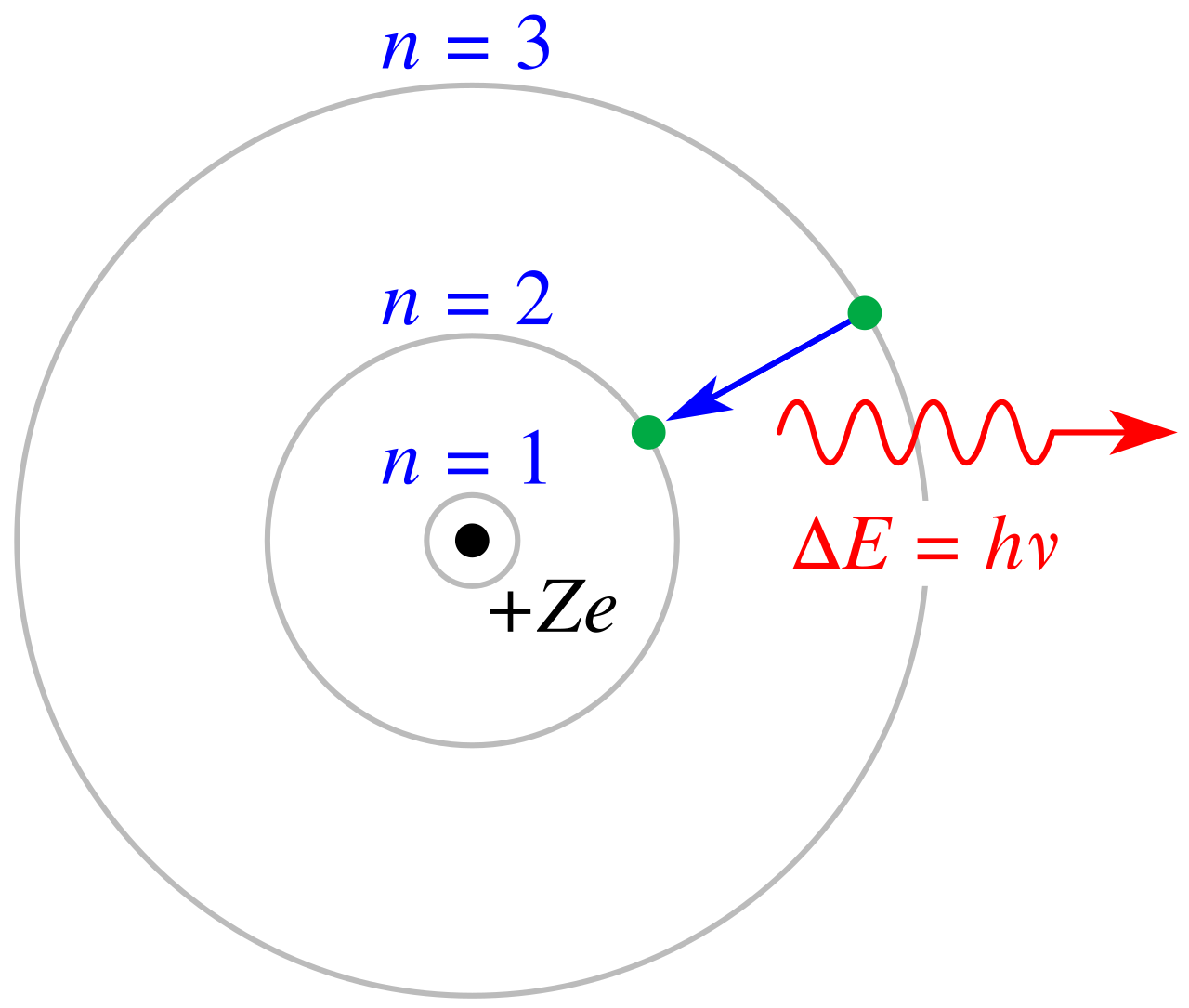
An electron emits light only when it jumps from a higher orbit to a lower one. The photon's energy exactly matches the gap between the two orbits. Since every jump has a fixed size, each jump gives one exact colour. For hydrogen, this explained the spectral lines physicists had measured for decades. The model only worked well for hydrogen-like atoms, and a fuller quantum theory replaced it in the 1920s, but its fixed energy levels survived.
Quiz me
0/3
Recap
An electron only emits or absorbs light by jumping between fixed orbits, and the size of the jump fixes the exact colour of the light.
Surprising fact · Rutherford's gold-foil result was so unexpected he likened it to a shell fired at tissue paper bouncing straight back.
Sources (5)
No source, no claim. Every fact in this lesson (12 claims) cites at least one of these.