Was Schrödinger's cat really meant to be alive and dead at once?
Erwin Schrödinger invented his famous cat to mock an idea, not to defend it. The joke became one of the most cited thought experiments in physics.
▶ Start the storyNo. Schrödinger's cat was never meant as a real claim that a cat could be alive and dead at once. Erwin Schrödinger invented it in 1935 to mock a view of quantum mechanics held by Niels Bohr and Werner Heisenberg. His point: scale that view up to something everyday, and it sounds absurd.
In his own words, the setup was 'completely burlesque'. A cat sits sealed in a steel chamber with a tiny amount of radioactive substance. In an hour, there's an even chance that one atom decays, or that none does. If one decays, a Geiger counter releases a hammer that shatters a flask of poison, killing the cat. Now suppose an atom really sits in a superposition of two states until it is measured. Then the whole box, cat included, should be a superposition of alive and dead until it's opened. Schrödinger found that ridiculous, and took it as a sign the picture was incomplete.
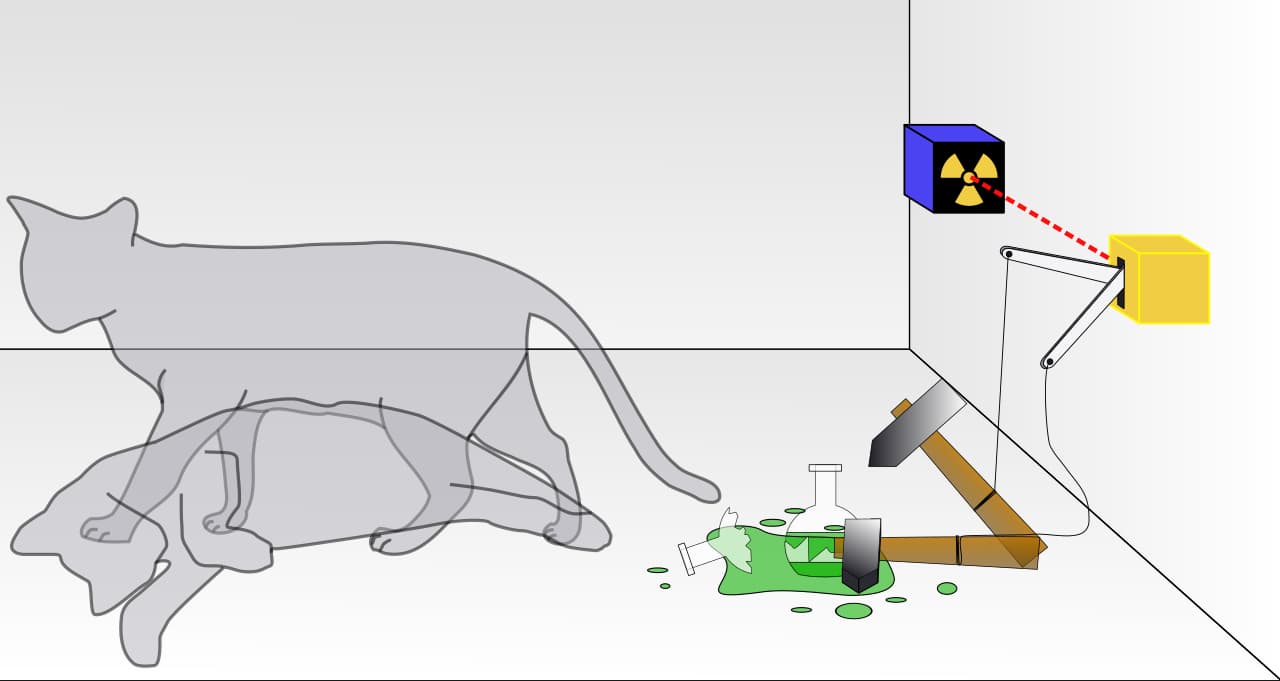
The joke took on a life of its own. Instead of settling the debate, it became its most famous picture. Physicists still argue about when and how a superposition turns into one definite outcome. This puzzle is called the measurement problem, and different interpretations answer it differently. One popular myth says a conscious mind is what decides; no research supports that.
Superposition itself is not in doubt. Experiments at the atomic scale have shown very small objects in superposition. Doing it with something as large as a cat would face enormous technical difficulties. Nobody has superposed a cat, and the thought experiment was never meant to be performed.
Quiz me
0/3
Recap
Superposition is real and tested for tiny objects, but the cat itself was always a joke, never an experiment anyone performed or intended to.
Surprising fact · Schrödinger called his own scenario 'completely burlesque', intending it as a joke against Bohr and Heisenberg, not a serious claim.
Sources (5)
No source, no claim. Every fact in this lesson (11 claims) cites at least one of these.