Why do neutrinos keep changing their identity in flight?
For decades, detectors caught only a third to a half of the neutrinos the Sun should be sending. The rest hadn't vanished: they had changed type.
▶ Start the storyNeutrinos change identity because each of their three 'flavors', electron, muon and tau, is not a single state but a different blend of three states with definite, slightly different masses. As a neutrino travels, the quantum phases of those mass states advance at slightly different rates, so the blend keeps shifting, and a different blend means a different mix of flavors. A neutrino born as an electron neutrino can therefore later be detected as another flavor, with the odds varying as it flies. Bruno Pontecorvo first predicted this in 1957.
The clue came from the Sun, which produces only electron neutrinos. In the late 1960s, Ray Davis's Homestake experiment, with a chlorine-based detector, measured fewer solar neutrinos than the Standard Solar Model predicted; in various experiments, the deficit was between one half and two thirds. This 'solar neutrino problem' lasted for decades. The explanation: many electron neutrinos had become other flavors on the way, invisible to detectors that only saw electron neutrinos.
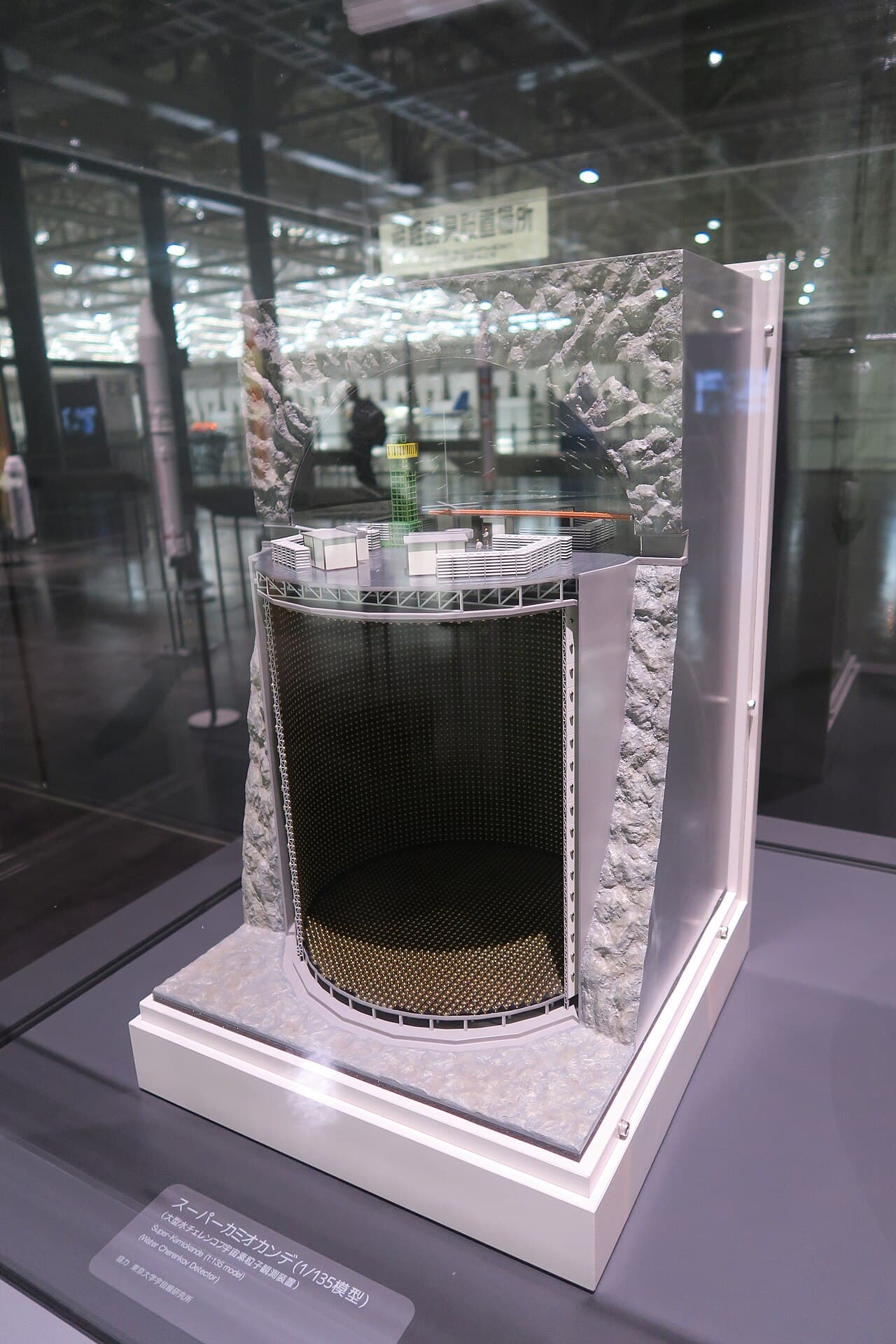
In 1998, Super-Kamiokande in Japan found fewer atmospheric neutrinos coming up through the Earth than straight down from above, consistent with muon neutrinos changing flavor inside the planet. Then the Sudbury Neutrino Observatory in Canada measured electron neutrinos and all flavors together: only about 34% were still electron neutrinos, in perfect agreement with prediction. Takaaki Kajita and Arthur B. McDonald shared the 2015 Nobel Prize in Physics; Pontecorvo, who died in 1993, was not included.
The result reached far beyond the Sun. Oscillation implies that neutrinos have mass, while the Standard Model had predicted them to be massless, so the discovery required modifying that theory.
Quiz me
0/3
Recap
A neutrino's flavor is a blend of slightly different masses, so as it travels the blend shifts and its flavor changes; that is why detectors seeing only electron neutrinos missed much of the Sun's output.
Surprising fact · SNO found that only about 34% of the solar neutrinos it detected were still electron neutrinos, in perfect agreement with prediction.
Sources (2)
No source, no claim. Every fact in this lesson (22 claims) cites at least one of these.