How can a particle pass through a wall it doesn't have the energy to climb?
A ball can't roll through a hill. An electron sometimes can, and your phone's memory, the Sun and radioactive rocks all depend on it.
▶ Start the storyBecause a particle is also a wave, and a wave doesn't stop dead at a wall. In quantum mechanics, an electron hitting an energy barrier it can't climb is mostly reflected, but a small part of its wave leaks out on the far side. That leak is a real probability of finding the particle there, so every so often it simply turns up beyond the barrier. Physicists call this quantum tunnelling. A ball rolling at a hill without enough speed always rolls back; an electron, now and then, goes through.
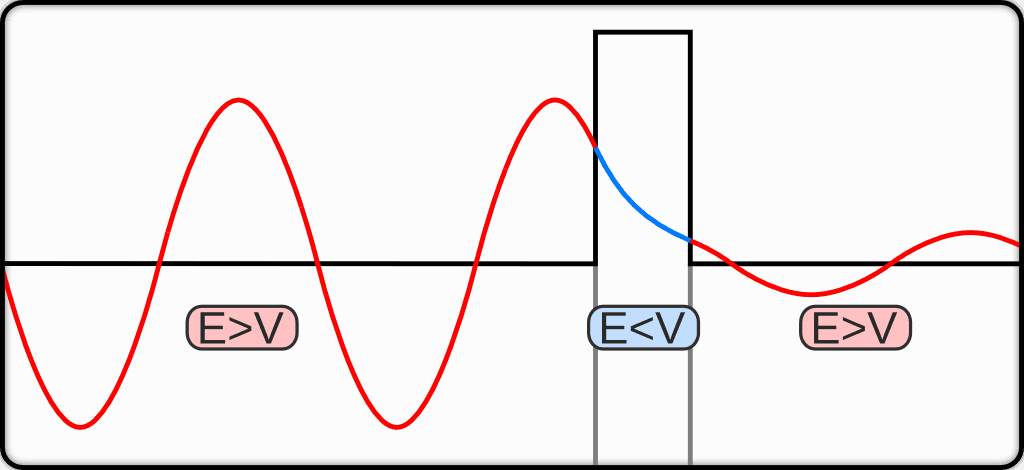
The odds fall off very fast, exponentially, as the barrier gets higher or wider or the particle gets heavier. That's why you never tunnel through your front door, but electrons routinely cross barriers a few atoms thick. Protons and even whole atoms have been seen doing it too.
Tunnelling explained a mystery in 1928. Radioactive nuclei spit out alpha particles that seemed to lack the energy to escape. George Gamow, and separately Ronald Gurney and Edward Condon, showed they tunnel out. An alpha particle hits the wall of its nucleus more than 10^21 times a second, and if each try has a tiny chance of success, the nucleus can last for ages: bismuth-209 has a half-life of about 2 × 10^19 years. The same trick runs in reverse inside the Sun, letting protons fuse at temperatures too low by classical rules.
You rely on it daily. Flash memory in phones and USB sticks is written by pushing electrons through a thin insulator. The scanning tunnelling microscope uses the tunnelling current to see individual atoms. And it sets a limit: in transistors thinner than about a nanometre, electrons tunnel straight through and leak away.
Quiz me
0/3
Recap
The odds of tunnelling fall exponentially with barrier height, width and particle mass, which is why electrons do it constantly and footballs never do.
Surprising fact · The physicist who explained alpha decay by tunnelling, George Gamow, twice tried to escape the Soviet Union by kayak.
Connects to
Sources (5)
No source, no claim. Every fact in this lesson (32 claims) cites at least one of these.