How can the fastest runner ever catch a tortoise, if he must first reach where it was?
Around 2,400 years ago, Zeno "proved" that motion is impossible, and it took until the 19th century for mathematics to fully tame the infinite steps his argument relies on.
▶ Start the storyHe catches it because an infinite number of ever-shorter steps can add up to a finite distance, covered in a finite time. But it took mathematicians more than two thousand years to say that rigorously.
The puzzle comes from Zeno of Elea, a Greek philosopher of the fifth century BC. Give a tortoise a 100-metre head start. By the time Achilles reaches the spot where it started, the tortoise has crawled on, say, 2 metres. By the time he covers those 2 metres, it has moved again, a little less. Every time Achilles reaches where the tortoise was, it is already somewhere else. So, Zeno argued, he needs an infinite number of steps and can never catch up.
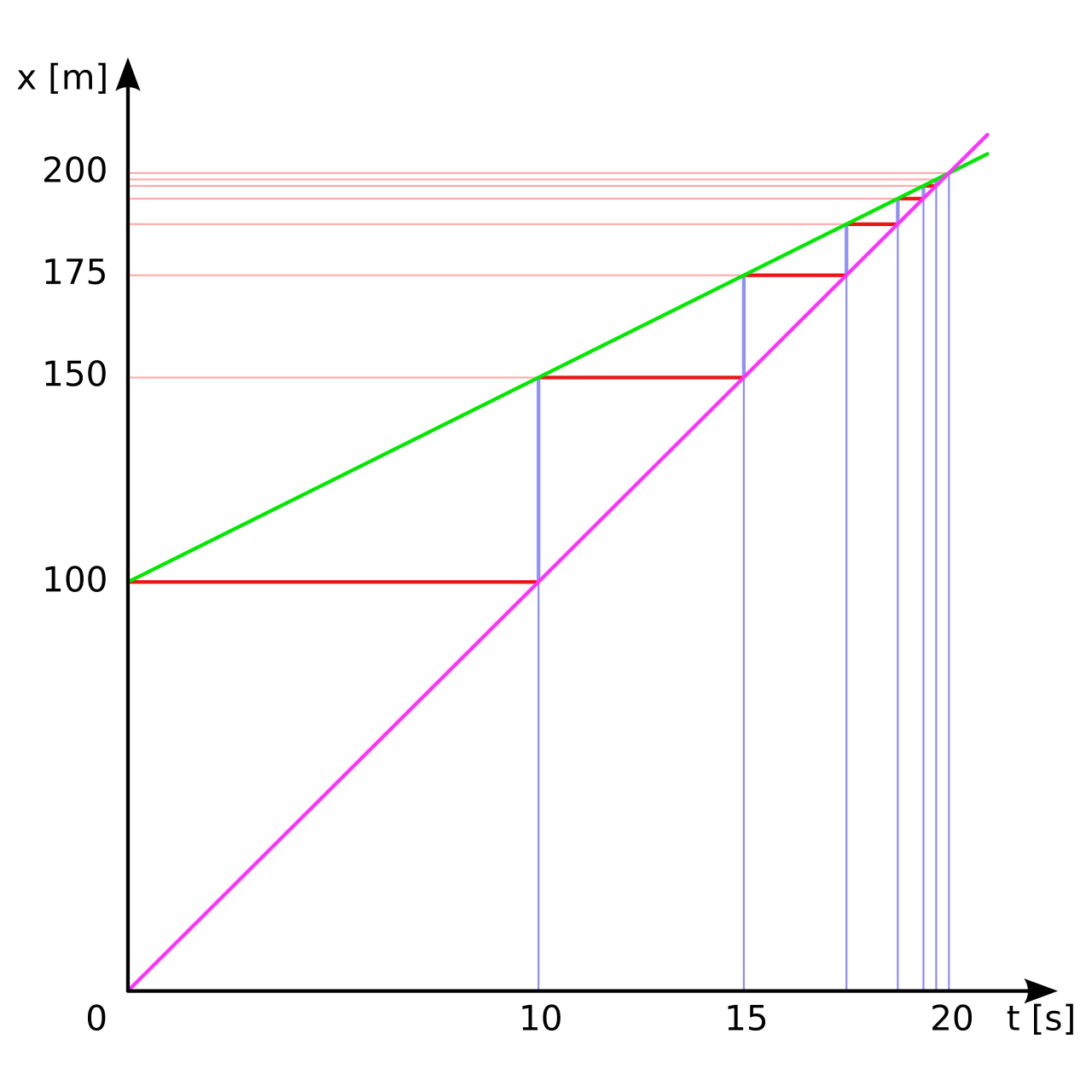
Zeno wasn't confused about races. He wanted to defend his teacher Parmenides, who taught that reality is one and unchanging and that our senses mislead us. If common sense about motion leads to absurdity, maybe motion itself is an illusion.
One ancient critic, Diogenes the Cynic, simply stood up and walked. But that shows the conclusion is wrong, not where the argument fails. The mathematical answer came with the idea of a limit, made rigorous only in the 19th century: the steps 1/2 + 1/4 + 1/8 + 1/16 and so on add up to exactly 1. Some philosophers still think that answers the arithmetic without answering Zeno's deeper question about completing infinitely many tasks.
Adding up Zeno's halves
| Share of the path covered | |
|---|---|
| 1 step | 0.5 |
| 2 steps | 0.75 |
| 3 steps | 0.875 |
| 4 steps | 0.938 |
| 5 steps | 0.969 |
| 6 steps | 0.984 |
| 7 steps | 0.992 |
| 8 steps | 0.996 |
Quiz me
0/3
Recap
1/2 + 1/4 + 1/8 + ... = 1: infinitely many ever-smaller steps can add up to one finite trip.
Surprising fact · Diogenes the Cynic's reply was to stand up and walk, which disproves the conclusion but doesn't show where the argument goes wrong.
Connects to
- 🌀 How can infinitely many numbers add up to something finite?
- Limit mathematics
- Infinity
- Parmenides
- Quantum zeno effect
Sources (2)
No source, no claim. Every fact in this lesson (16 claims) cites at least one of these.