How does one species split into two?
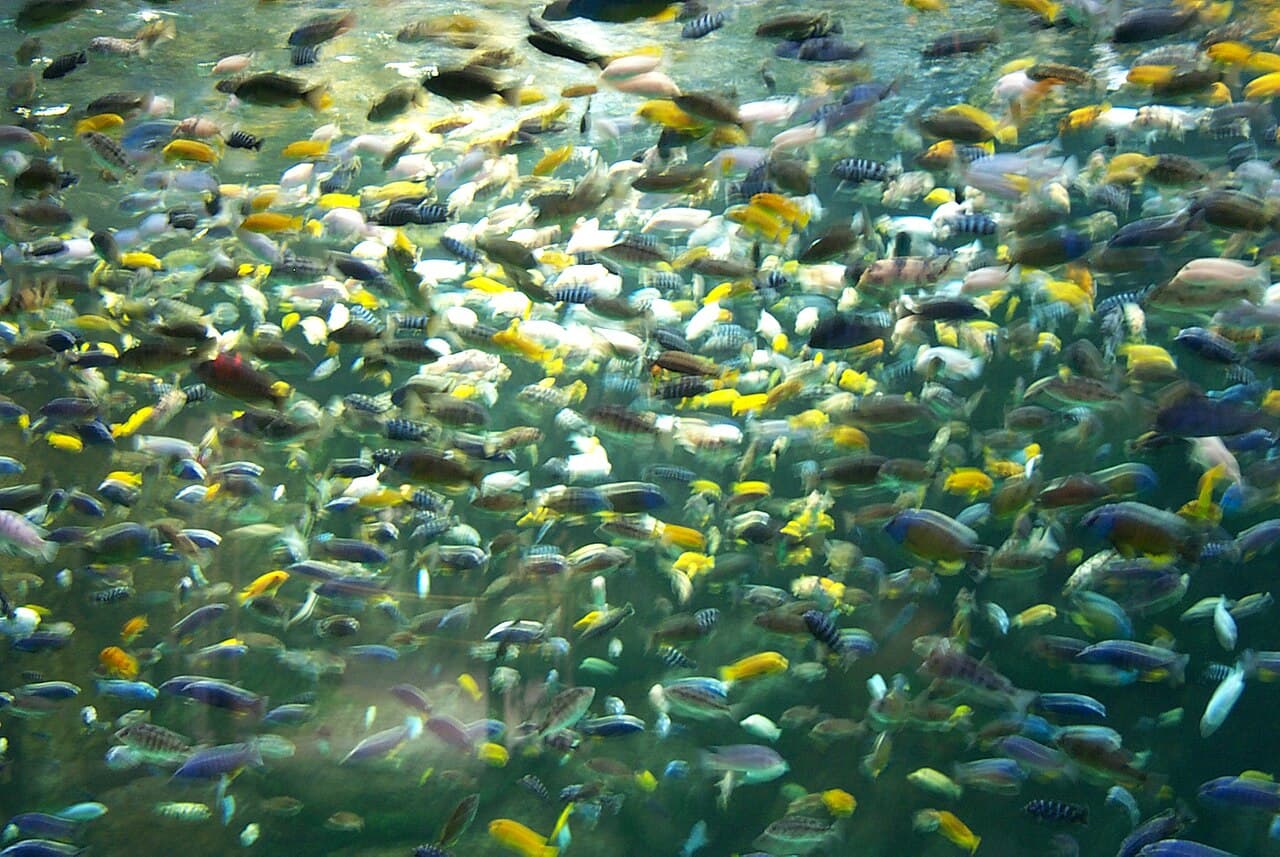
East Africa's great lakes hold more than 800 kinds of cichlid fish, many sharing the same water. Mountains and oceans aren't the only way to split a species.
▶ Start the storyA species splits in two when its populations can no longer interbreed. Biologists call this reproductive isolation. It is now widely agreed to be the critical step in the birth of a new species.
The classic route is geography. A mountain range rises, or some other barrier cuts a population in two. Each half changes in its own way. If they meet again, they may no longer be able to exchange genes. Sometimes a small group gets cut off at the edge of the range. In such tiny groups, chance is thought to play a big part.
Hybrids can seal the split. If the offspring of two diverging groups are sterile, or simply less fit, as with horses and donkeys, the separation deepens. This is sometimes called the Wallace effect, after the naturalist Alfred Russel Wallace.
Distance isn't always needed. East Africa's great lakes, Victoria, Malawi and Tanganyika, hold more than 800 described species of cichlid fish, and perhaps well over 1,600. They are the best-known case of species splitting while sharing the same place, shaped by both natural selection and the choice of mates. Even so, geography lent a hand. Lake Malawi's level has dropped by hundreds of metres dozens of times, cutting fish populations apart before reuniting them.
The line between one species and two can blur. The greenish warbler is thought to have spread from Nepal around both sides of the Tibetan Plateau. Neighbouring groups interbreed all along the way. Yet where the two ends meet, in Siberia, they appear not to. Biologists still debate such "ring species". But as Richard Dawkins put it, they show in space what must always happen in time.
Quiz me
0/3
Recap
Two populations become two species once they can no longer produce fertile offspring together, whether a barrier split them or not.
Surprising fact · More than 800 cichlid species have been described in East Africa's great lakes, many of them formed while sharing the same water.
Connects to
- 🎲 Can a species evolve by pure luck, with no selection at all?
- 🐦 Why did a few small birds on the Galápagos change how we see life?
- ⏱️ How can differences in DNA tell when two species parted ways?
- 🦋 How does natural selection actually change a species?
- 🌳 How can linguists rebuild a language no one ever wrote down?
Sources (4)
No source, no claim. Every fact in this lesson (19 claims) cites at least one of these.