Why did a few small birds on the Galápagos change how we see life?
Darwin barely noticed these birds. It took a bird expert in London to tell him what he had found.
▶ Start the storyThese birds suggested that species are not fixed: one ancestor can turn into many. Yet Darwin almost missed them. During his five weeks on the Galápagos, he was mostly studying rocks. He left most of the bird shooting to his servant, Syms Covington.
Back in London, the bird expert John Gould examined the specimens. Darwin had labelled them blackbirds, grosbeaks and finches. Gould saw they were all finches: a whole new group of 12 species, found nowhere else. Today about 18 species are counted. All are thought to descend from one finch species that reached the islands over a million years ago.
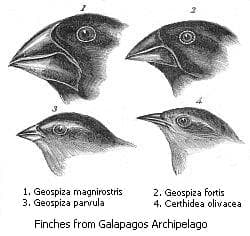
What sets them apart is the beak. Each species has a beak sized and shaped for its own food, from huge and heavy to small and slender. Darwin was struck by this smooth gradation. In 1845 he wrote that it was as if one species had been "taken and modified for different ends."
The biologists Peter and Rosemary Grant later watched these beaks change. From 1973, they spent six months of every year on the tiny island of Daphne Major, catching and measuring finches. In 1977, only 24 millimetres of rain fell. The small, soft seeds ran out, and only big, tough ones were left. Many finches died. Those with bigger beaks could crack the seeds and breed. After the drought, the population had measurably larger beaks.
Then, in 1981, a heavy stranger arrived with an unfamiliar song. Local females didn't recognize the song of his line, so his descendants bred only among themselves. Biologists now describe them as a new species: the first one scientists watched form in the wild.
Quiz me
0/3
Recap
One ancestral finch, spread across islands with different foods, became many species with very different beaks.
Surprising fact · After a single drought in 1977, the finches on one tiny island had measurably larger beaks.
Sources (2)
No source, no claim. Every fact in this lesson (32 claims) cites at least one of these.