How can a few master genes reshape a whole body plan?
Put a mouse gene into a fruit fly, and it can trigger an eye. The same ancient switch helps build very different eyes.
▶ Start the storyA few master genes can reshape a body because they don't build anything themselves. They act as switches, telling cells what to become and where. Change when or where a switch flips, and the body changes. So new body shapes often come from rewiring old switches, not from inventing new genes.
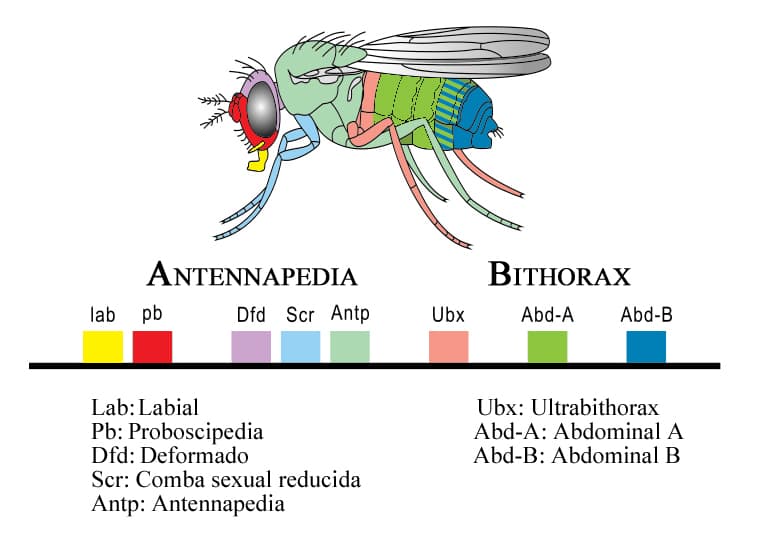
Fruit flies show how strong one switch can be. A gene called Antennapedia normally helps tell one segment of the fly to grow legs. A single mutation can switch it on in the head instead. The fly then grows legs where its antennae should be.
Genes like this, called Hox genes, lay out the body from head to tail. Like a play's director, they don't act in the play: they decide what goes where. Their order on the chromosome usually matches the order of the body parts they control. In 1995, Edward Lewis, Christiane Nüsslein-Volhard and Eric Wieschaus shared a Nobel Prize for finding key genes behind the fly's body plan.
The biggest surprise came from eyes. Biologists such as Ernst Mayr thought eyes had evolved at least 40 separate times. Then, in 1994, Walter Gehring found that pax-6, a gene needed to build a fly's eye, matches an eye-forming gene in mice and humans. Mouse Pax6 can even trigger eye development in a fruit fly, though fly eyes and mouse eyes are built very differently.
These switches are ancient. Hox genes likely arose over 550 million years ago, yet a fly can work largely normally with a chicken Hox protein in place of its own. Evolution keeps reusing this old toolkit. In one of Darwin's finches, a toolkit gene called BMP helped make a bigger beak.
Quiz me
0/3
Recap
Toolkit genes like Hox and PAX6 specify position and identity without building structures themselves, the way a director calls scenes without acting in them.
Surprising fact · Mouse Pax6 can trigger eye development in a fruit fly, even though fly eyes and mouse eyes are built very differently.
Connects to
- 🧬 Where do brand-new traits come from in the first place?
- 🐦 Why did a few small birds on the Galápagos change how we see life?
- 🐠 How does one species split into two?
- 👁️ Could a complex eye like ours really evolve one small step at a time?
- 🦐 Why did almost every animal body plan appear in a geological instant?
Sources (3)
No source, no claim. Every fact in this lesson (25 claims) cites at least one of these.