How can linguists rebuild a language no one ever wrote down?
Nobody has ever read a single word of Proto-Indo-European, yet linguists know how its speakers said 'water', 'hound' and 'three'.
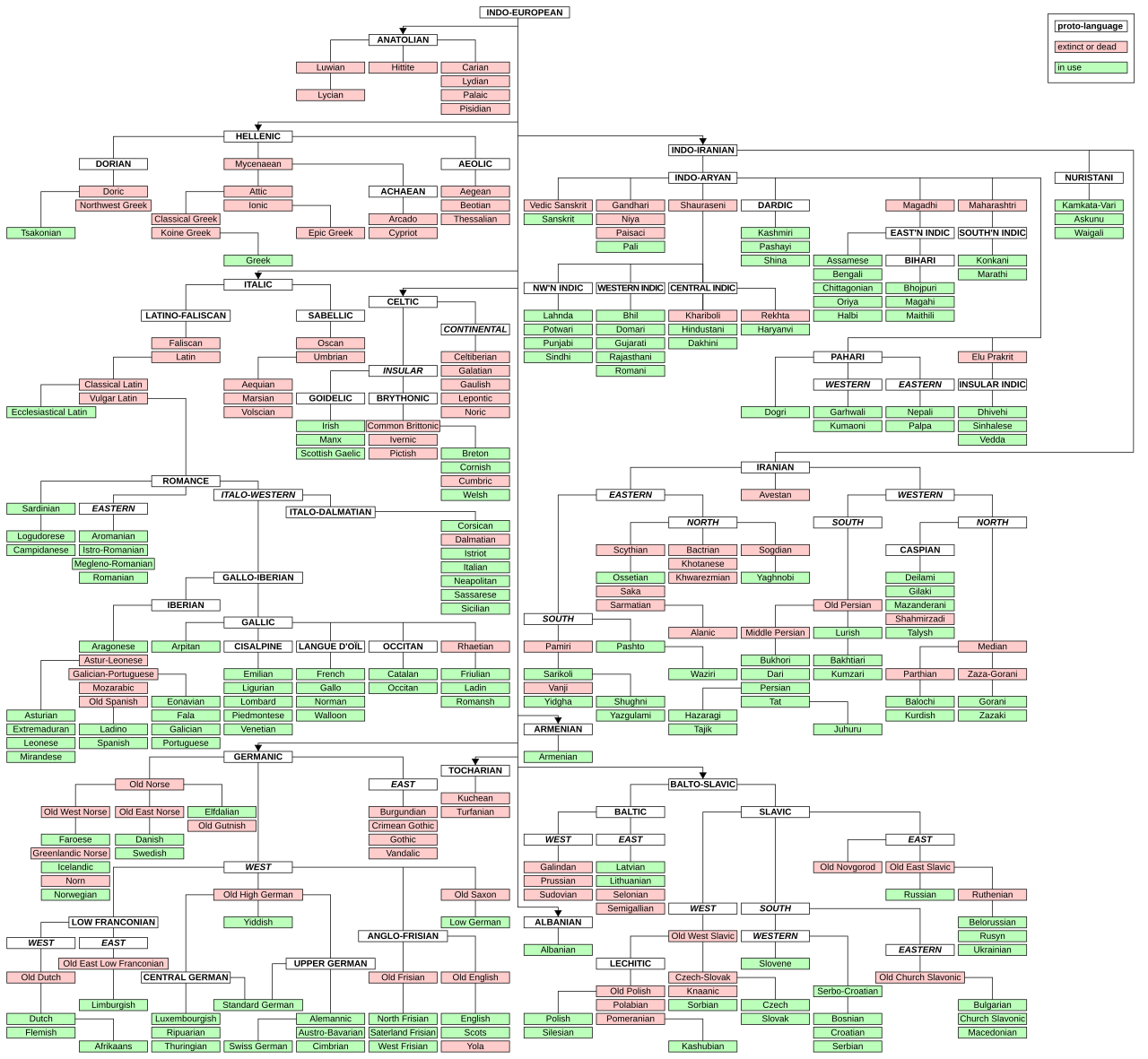
▶ Start the storyLinguists rebuild an unwritten language by comparing its descendants. Proto-Indo-European, the ancestor of languages from English and French to Hindi and Persian, left no written record at all. But when sounds change, they change regularly, so the daughter languages keep matching patterns. Compare Italian piede, padre, pesce with English foot, father, fish: the p and the f line up far too often to be a coincidence. Collect enough of these correspondences and you can work backwards to the parent word.
That is how linguists know that the ancestors of English water, hound and three were something like *wódr̥, *ḱwn̥tós and *tréyes, the asterisk meaning 'reconstructed, never seen'. The language was probably spoken between about 4500 and 2500 BCE, perhaps on the steppes north of the Black and Caspian seas, before migrations split it into dialects that became separate languages.
Italian
- piede
- padre
- pesce
English
- foot
- father
- fish
The idea caught on thanks to William Jones, a British judge in India who learned Sanskrit to check the court's legal experts. In 1786 he declared that Sanskrit, Greek and Latin were too alike to be an accident and must share a common source that perhaps no longer exists. A French Jesuit, Gaston-Laurent Coeurdoux, had noticed the same thing twenty years earlier. Today over 3.4 billion people speak a descendant of that lost language.
Quiz me
0/3
Recap
Sounds change by rules, so matching patterns in daughter languages let you run the film backwards to the parent.
Surprising fact · A French Jesuit, Coeurdoux, spotted the Sanskrit–European connection in 1767, before William Jones's famous 1786 lecture.
Connects to
- 🔎 How do linguists tell real language relatives from lookalikes?
- 👨👦 Why does English say 'father' where Latin says 'pater'?
- Indo european languages
- Sanskrit
- Kurgan hypothesis
Sources (3)
No source, no claim. Every fact in this lesson (16 claims) cites at least one of these.