How do still pictures become a moving film?
Textbooks often say images 'linger on your retina'. Psychologists rejected that idea over a century ago.
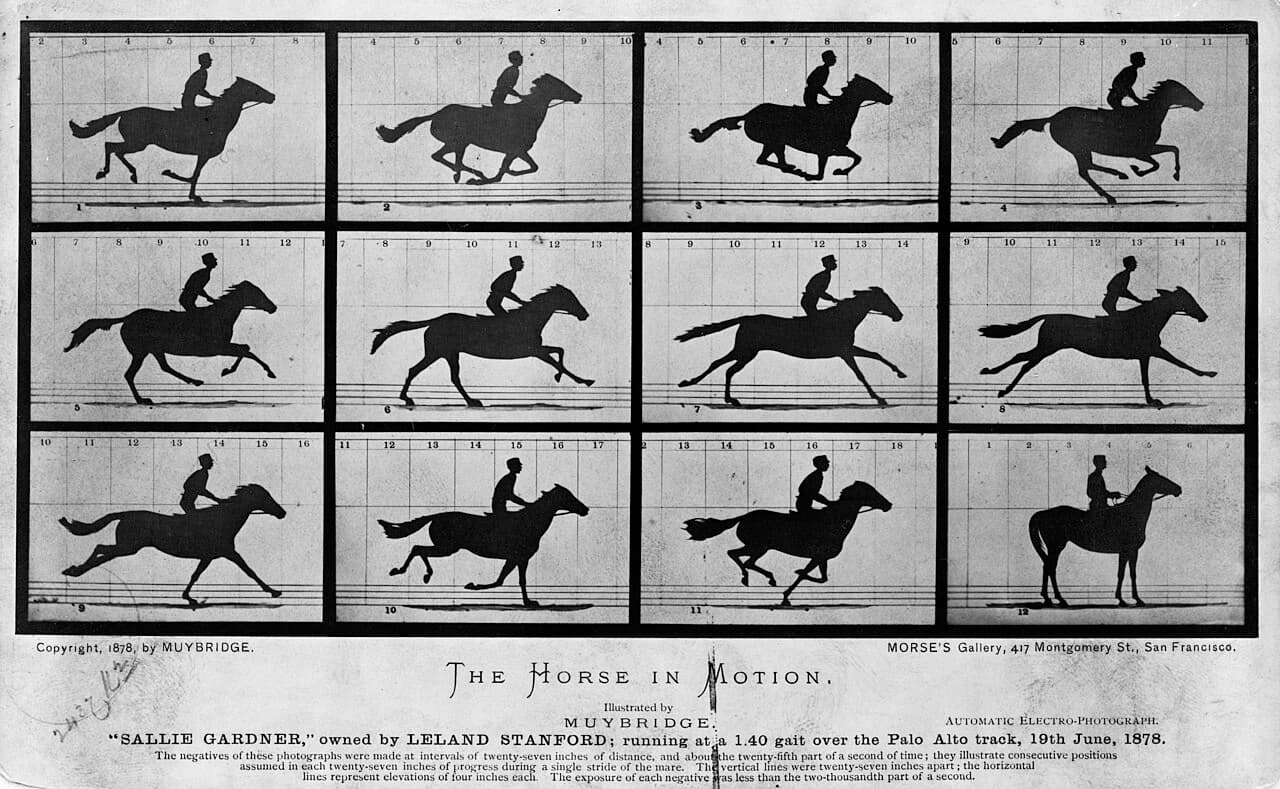
▶ Start the storyA film is a long series of still pictures, called frames, shown so quickly one after another that your brain sees motion instead of a slideshow. Show animation frames at 16 or more per second and the movement looks continuous. The motion is not on the screen: it is constructed in your head.
For a long time, the standard explanation was persistence of vision, the idea that each image lingers on the retina for a moment and blends into the next, the way a glowing coal whirled in the dark leaves a fiery trail. That story is still repeated, including in many film-theory books. But psychologists and physiologists have rejected it as the explanation for watching films. As early as 1868, William Carpenter suggested the effect was more mental than retinal.
The decisive test came in 1912, when the psychologist Max Wertheimer flashed two similar shapes in two nearby places. At the right speed, people saw a single shape moving, yet they saw nothing in the gap between the two positions. Nothing was lingering; the brain was inferring motion. His study, run on his own colleagues, led to the founding of Gestalt psychology.
Today's view is that the eye is not a camera and does not see in frames per second. In film, each frame differs only slightly from the last, and our visual system cannot tell this kind of apparent motion from real movement. Persistence of vision survives in a narrower role: when flashes come too fast to tell apart, they fuse into steady light, which is why we don't notice the flicker between frames.
Old story: persistence of vision
- Each image lingers on the retina
- Frames blend into one another
- Still repeated in many film books
Modern view: apparent motion
- The brain infers motion between frames
- Nothing is seen in the gap
- Flicker fusion only hides the dark gaps
Quiz me
0/3
Recap
The eye is not a camera: films move because your brain reads small changes between still frames as motion.
Surprising fact · Persistence of vision, the classic textbook explanation, was rejected by psychologists but still appears in many film-theory books.
Connects to
- 🎞️ Why do movies run at exactly 24 frames per second?
- 🔮 Does your brain see the world, or predict it?
- Beta movement
- Gestalt psychology
Sources (4)
No source, no claim. Every fact in this lesson (19 claims) cites at least one of these.