How did one 7-kilogram box film, print and project movies?
It could film, print and project, all with one hand-cranked device light enough to carry like a camera.
▶ Start the storyBy doing all three jobs with the same hand-cranked mechanism. The Cinématographe Lumière, patented in 1895, weighed about 7.3 kilograms and could record moving pictures, print a positive copy from the negative, and, with just a light source and a flat surface in a dark room, project the result on a screen. Edison's rival Kinetoscope was bulky, needed electricity and showed its films to one person at a time through a peephole; the Lumières wanted a machine about as simple to use as an ordinary photographic camera.
The name was not even theirs. In 1892 the French inventor Léon Bouly patented a "Cinématographe", and in 1893 an improved version that could also project its images. But he paid his annual patent fees only once, the patents lapsed at the end of 1894, and he seems to have abandoned the project. The Lumière brothers filed their own patent in February 1895. The next month, Louis Lumière showed his first film, workers leaving the family factory, as a side note to a lecture on photographic plates; the few dozen guests were so enthusiastic that they demanded to see it again.
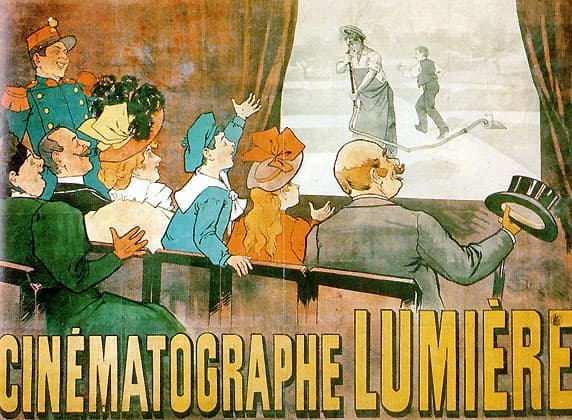
On 28 December 1895 the brothers put on a paid show at the Grand Café in Paris: ten films of about 50 seconds each. It is often called the first commercial film screening, but that was the Eidoloscope, shown in New York that May. The light machine travelled well: the Lumières took it to China and India, and it became a popular attraction around the world. Yet the all-in-one idea was abandoned within a few years, as filmmaking stayed in professional hands and the trade wanted specialised cameras and specialised projectors.
7.3 kg
Quiz me
0/3
Recap
The Lumières' Cinématographe did a photographer's whole job, shooting, printing and projecting, in one 7-kilogram box.
Surprising fact · The word 'cinématographe' was coined in 1892 by Léon Bouly, who let his own patents lapse and abandoned the project.
Sources (2)
No source, no claim. Every fact in this lesson (19 claims) cites at least one of these.