Why was the Cold War called 'cold'?
For more than four decades the United States and the Soviet Union prepared to destroy each other, yet their armies never fought each other directly.
▶ Start the storyIt was 'cold' because the two superpowers never fought each other directly. From the end of the Second World War until the Soviet Union dissolved in 1991, the United States and the USSR competed in almost every other way: an arms race, a space race, spying, propaganda, embargoes, even sport. The shooting happened elsewhere, in 'proxy wars' where each side backed opposite camps, so for many countries the Cold War was anything but cold.
The phrase itself has a literary history. George Orwell used 'cold war' in an essay published in October 1945, imagining a world under the shadow of the atomic bomb, with states that could not be conquered locked in a permanent 'cold war' with their neighbours. In April 1947 the American adviser Bernard Baruch applied it to the US–Soviet standoff: 'we are today in the midst of a cold war.' The journalist Walter Lippmann made it famous and traced it to a French phrase of the 1930s, la guerre froide.
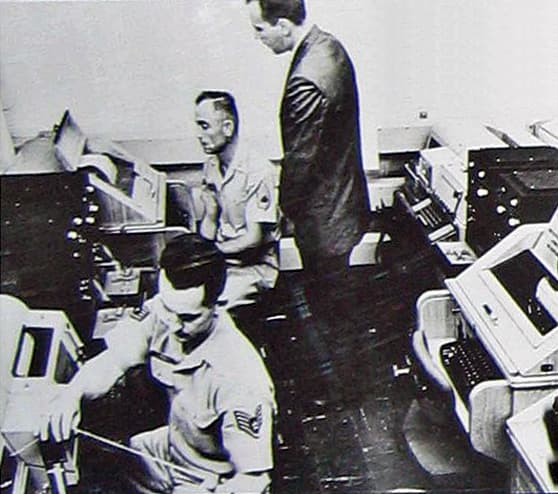
Nuclear weapons kept it cold. Once both sides had the bomb, an all-out attack would have destroyed attacker and defender alike, a logic strategists called mutual assured destruction, or MAD. The scariest moment came in 1962, during the Cuban Missile Crisis, when messages between the two leaders took hours to arrive. Afterwards they set up a direct hotline. Despite the legend, it was never a red telephone: it was a teleprinter, and its first message was 'the quick brown fox jumped over the lazy dog's back'.
Quiz me
0/3
Recap
Cold between the superpowers, hot in the proxy wars: mutual assured destruction kept the main event from starting.
Surprising fact · Orwell used 'cold war' in 1945, and the US–Soviet hotline set up after the Cuban Missile Crisis was a teleprinter, not a red phone.
Connects to
- ☢️ Did one officer's refusal really stop a nuclear torpedo launch?
- 🚗 How did a wrong turn in Sarajevo help start World War I?
- 📦 How does the internet deliver your data without ever giving you a line of your own?
- ♟️ How can you predict what people will do when each one's best move depends on the others?
- 💬 What was the first message ever sent over the internet's ancestor?
Sources (3)
No source, no claim. Every fact in this lesson (19 claims) cites at least one of these.