What was the first message ever sent over the internet's ancestor?
It was supposed to say 'login'. The computer at the other end crashed after two letters.
▶ Start the storyThe first message sent over ARPANET, the network that grew into the internet, was 'lo'. Not by design: at 10:30 pm on 29 October 1969, a UCLA student named Charley Kline tried to log in to a computer at the Stanford Research Institute by typing the command 'login'. The machine at the other end crashed after two characters. About an hour later, after programmer Bill Duvall adjusted it, Kline tried again and logged in successfully.
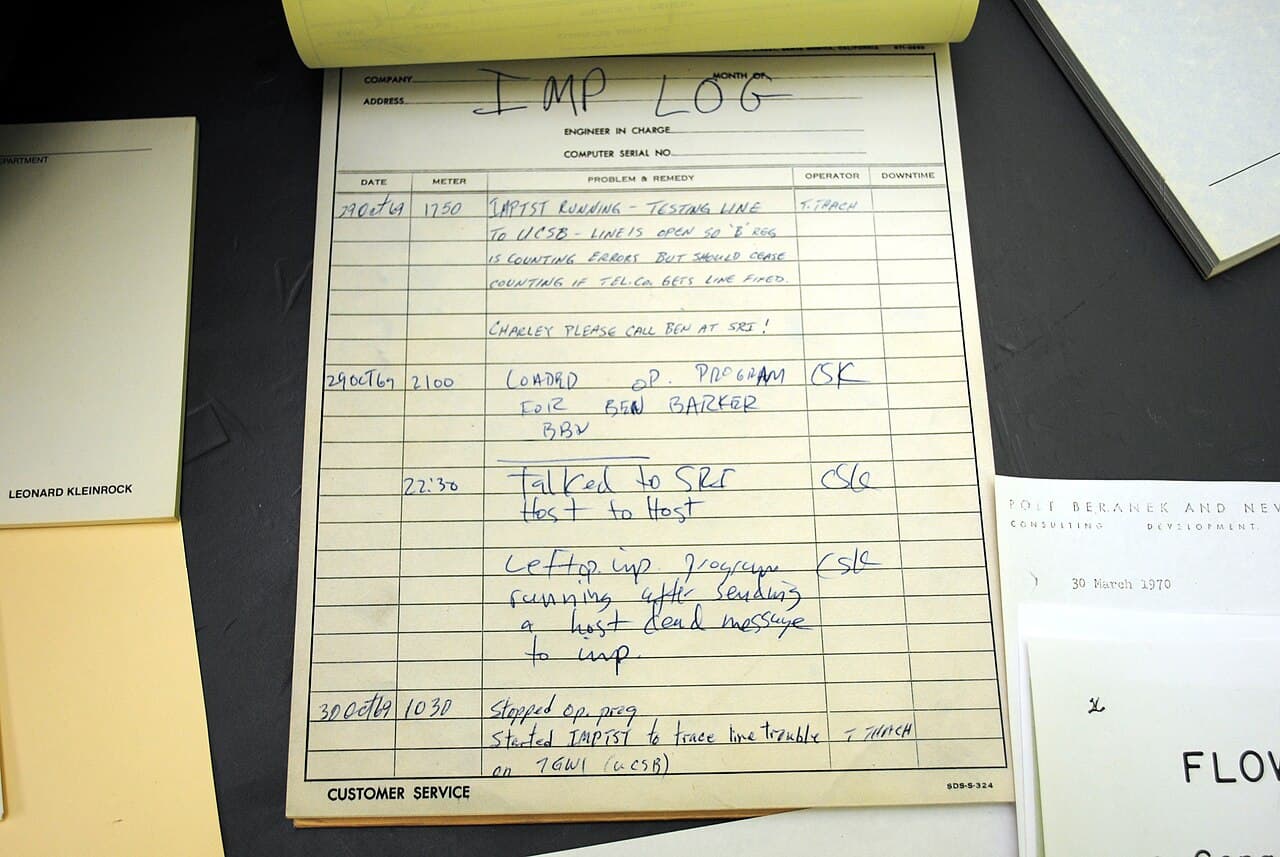
ARPANET was launched in 1966 by Bob Taylor at the US Defense Department's research agency, so that distant computers could share resources. Many computer companies found the idea outlandish, and only twelve bid to build it. Within weeks of that first 'lo', a permanent link joined UCLA and Stanford, and by December 1969 four sites were connected.
What made it new was packet switching. Instead of reserving a whole line for one conversation, as telephone calls did, the network chopped data into short packets. Each packet has a header, like an address on an envelope, and a payload, the actual content. Small computers called IMPs, the ancestors of today's routers, passed packets from one to the next until they arrived.
The idea had roots in the early 1960s, when Paul Baran was studying networks that could keep working even if parts were destroyed, for instance in a nuclear war, and in the work of Britain's Donald Davies, who coined the term packet switching. On 1 January 1983 ARPANET switched to TCP/IP, which together with packet switching became the technical foundation of the internet. Not bad for a network whose first word was a crash.
Quiz me
0/3
Recap
The internet's first word was a crash: 'lo', sent from UCLA to Stanford on 29 October 1969.
Surprising fact · Its first message was 'lo': the receiving computer crashed after two letters of 'login'.
Sources (3)
No source, no claim. Every fact in this lesson (16 claims) cites at least one of these.