Why do scientists think Mars might once have had life?
In the 1970s, an experiment on Martian soil sent back a signal that looked like metabolism. Decades later, scientists still can't say for sure whether it was biology or chemistry.
▶ Start the storyScientists think Mars might once have had life because, billions of years ago, its surface held liquid water and may have been habitable for microorganisms, even though habitable conditions don't prove life actually showed up. At least two-thirds of Mars's surface is more than 3.5 billion years old, and parts of it could have been habitable 4.48 billion years ago, half a billion years before the earliest known life appeared on Earth.
The idea that Mars might be inhabited is much older than space probes. In 1854, a Cambridge scholar theorized Mars had seas and possibly life, and by the late 1800s astronomers thought they saw straight-line 'canals' crisscrossing the planet. Percival Lowell ran with the idea, publishing books in 1895 and 1906 arguing the canals were built by a long-gone alien civilization, which inspired H. G. Wells to write The War of the Worlds. Other scientists pushed back hard: in 1907, naturalist Alfred Russel Wallace published a rebuttal concluding Mars was 'absolutely uninhabitable', and after spectroscopy in 1894 had found no water or oxygen in the Martian atmosphere, sharper photographs formally discredited the canals in 1909.
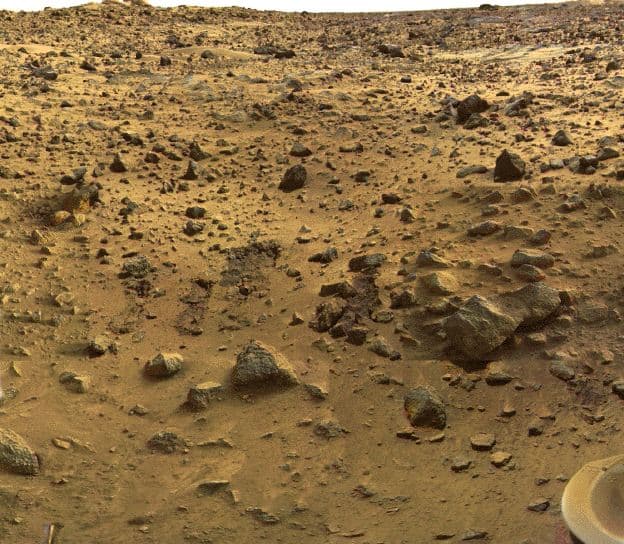
Real evidence came later, and it has stayed stubbornly ambiguous. In the 1970s, NASA's twin Viking landers ran a test called the 'Labeled Release' experiment, which returned a positive signal for metabolism, but a separate instrument found no organic compounds at all, so the result was declared inconclusive rather than a discovery. A 2010 study suggested a chemical called perchlorate in Martian soil could destroy organic matter when heated, which would explain why Viking's instruments came up empty even if organics had been there. More recent missions have kept the mystery alive: in 2018, NASA detected methane levels on Mars rising and falling with the seasons, a gas that can come from microbes or from ordinary geology, and in 2025, the Perseverance rover reported a possible biosignature in a rock nicknamed Cheyava Falls.
Whatever the answer, it probably isn't sitting on the surface today. Mars has no global magnetic field to shield it, and the radiation at its surface is strong enough to sterilize dormant life; researchers calculate that viable dormant cells could only be retrieved from deeper than 7.5 metres, so any evidence that survives is more likely buried underground.
Quiz me
0/3
Recap
Mars had the ingredients for life billions of years ago, but today's radiation-blasted surface means any evidence left behind is most likely buried deep below ground.
Surprising fact · A 1970s Viking lander test returned a signal that looked like microbial metabolism, but a second instrument found no organic molecules at all, leaving the result unresolved to this day.
Sources (1)
No source, no claim. Every fact in this lesson (17 claims) cites at least one of these.