Why did astronomers think Mars was covered in canals?
For decades, respected astronomers drew dozens, even hundreds, of straight lines across Mars, and some called them irrigation canals built by a desperate civilization. They didn't exist.
▶ Start the storyBecause of blurry telescopes, a mistranslated word and a planet that looked a lot like Earth. In the late 19th and early 20th centuries, serious astronomers believed Mars was crossed by a network of long straight canals, and some thought them the work of an intelligent civilization. It began in 1877, when Giovanni Schiaparelli sketched thin lines on Mars and called them canali, Italian for channels. The word was mistranslated into English as canals, which sounds engineered rather than natural, and the idea took off from there.
Without photography, astronomers had to stare through a telescope for hours, waiting for a split second of still air, then draw from memory what they thought they saw. Mars already looked eerily Earth-like: its day length and tilt were close to Earth's, it had seasons, and its ice caps grew and shrank. Astronomers read oceans into its dark patches. So when Percival Lowell adopted the idea that the canali were irrigation canals, built by a desperate civilization to tap the polar ice caps of a drying planet, the story fit what astronomers thought they knew, and he spent the rest of his life promoting it.
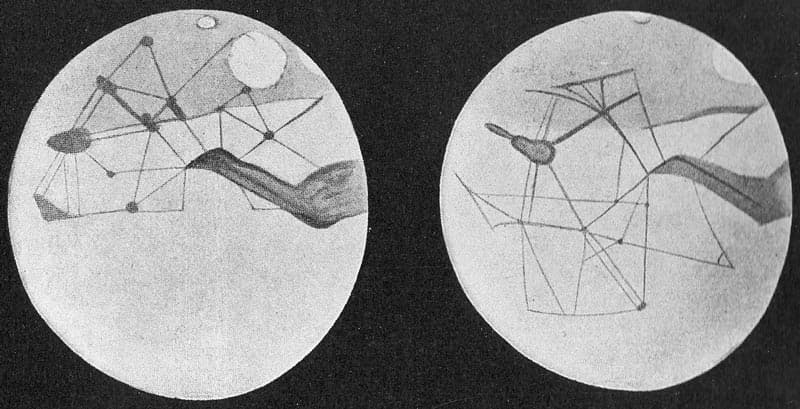
Others were more skeptical. In 1903, two researchers used schoolboy volunteers to show that the canals could be an optical illusion: through a poor telescope, many scattered dots appear to join up into lines. In 1907, the naturalist Alfred Russel Wallace argued that Mars was much colder than Lowell thought, and its air too thin for liquid water to exist on the surface. The debate dragged on until 1965, when NASA's Mariner 4 probe flew past Mars and photographed craters and a barren landscape, under an atmosphere less than one percent as dense as Earth's. There were no canals, and never had been.
Quiz me
0/3
Recap
Schiaparelli's Italian word canali (channels) was mistranslated as canals, and Percival Lowell built a lifelong theory of a Martian civilization on it, until Mariner 4 photographed a barren, crater-covered desert in 1965.
Surprising fact · A 1903 experiment with schoolboy volunteers showed that a poor telescope makes scattered dots appear to join into lines, suggesting how the canals could be 'seen'.
Sources (2)
No source, no claim. Every fact in this lesson (17 claims) cites at least one of these.