Why does SETI mostly listen for radio instead of light?
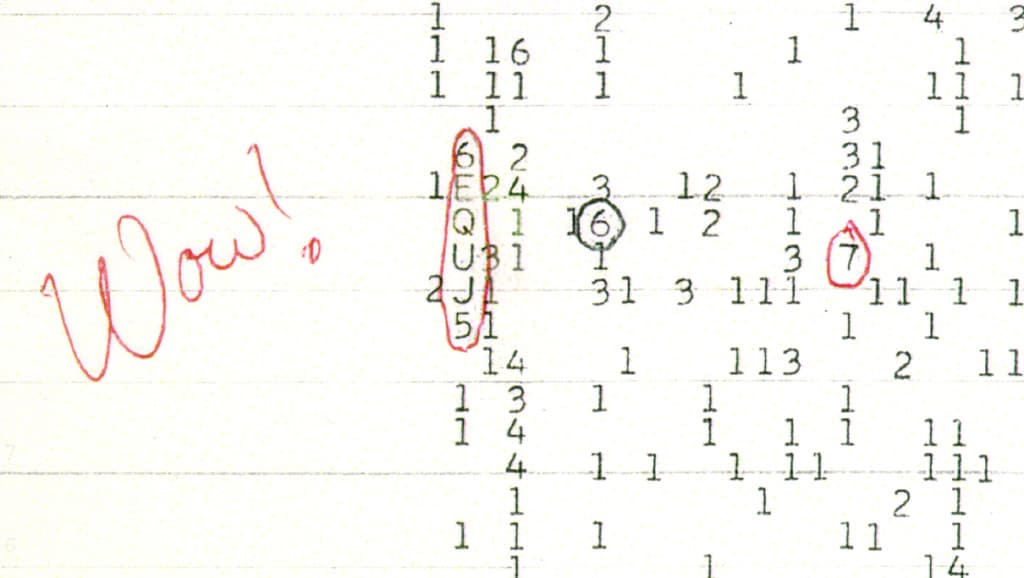
In 1977, a volunteer scanning a printout from a radio telescope saw a signal so strong he circled it and wrote 'Wow!' in the margin. It was never heard again.
▶ Start the storyIf aliens were trying to reach us, how would we even listen? Since 1959, when physicists Philip Morrison and Giuseppe Cocconi proposed scanning the microwave spectrum, SETI's landmark searches have pointed radio telescopes at the sky rather than looking for flashes of light. Radio has one huge advantage: a transmitter can broadcast in every direction at once, so you don't have to guess which way a signal is aimed.
Frank Drake tested the idea in 1960 with Project Ozma, pointing a radio dish at two nearby stars near a marker frequency nicknamed the 'water hole' because it lies close to the natural radio lines of hydrogen and hydroxyl. He found nothing of interest. In 1977, though, an Ohio State volunteer named Jerry Ehman spotted a signal so unexpectedly strong that he circled it on the printout and scrawled 'Wow!' in the margin. Some consider it the best candidate ever found for an artificial alien radio signal, yet several follow-up searches never detected it again.
Lasers have been considered too, since the 1960s. The problem is the opposite of radio's advantage: a laser beam is a narrow, aimed spotlight, not a broadcast, so it would have to be pointed exactly at Earth to be seen, even though such beams can travel enormous distances through the mostly transparent dust between stars. Brightness is not the obstacle: analysis shows an infrared laser pulse focused by a ten-meter mirror would look thousands of times brighter than the Sun to anyone in its beam.
So far, decades of listening, from the never-built $10 billion Project Cyclops dish array to the modern $100 million Breakthrough Listen project, have found nothing confirmed. Researchers have widened the search to 'technosignatures', any sign of technology, from megastructures such as Dyson spheres to city lights on distant planets, but a team that examined some 100,000 nearby large galaxies found none with obvious signs of a highly advanced civilization.
Quiz me
0/3
Recap
Radio signals spread in all directions, so SETI didn't need to guess where to point; lasers are far brighter but must be aimed exactly at Earth, which is why radio dominated the search for decades.
Surprising fact · In 1977, the Wow! signal appeared so much stronger than background noise that a volunteer circled it and wrote 'Wow!' on the printout, but it was never detected again.
Sources (1)
No source, no claim. Every fact in this lesson (13 claims) cites at least one of these.