What shape encloses the most area for a given perimeter?
A legendary queen is said to have won a whole hill with one oxhide, by cutting it into thin strips and running them around it.
▶ Start the storyOf all the shapes you could draw with a loop of a given length, the circle always encloses the most area. That's the isoperimetric inequality: for a closed curve of length L enclosing area A, you always have 4πA ≤ L², and the two sides are only ever equal when the curve is a circle. No other shape, however clever, beats it.
A legend tells the same idea as a story, a geometry problem in disguise. Dido, the legendary queen who founded Carthage, is said to have bargained with locals for only as much land as a single oxhide could enclose. Rather than lay the hide flat, she cut it into fine strips and used them to encircle an entire hill, afterwards named Byrsa, meaning 'hide'. Mathematicians named a close cousin of the question after her: Dido's problem asks for the largest area you can enclose between a straight line and a curved arc whose ends sit on that line.
Ancient Greek mathematicians already knew the circle was the answer, but knowing isn't the same as proving it: a fully rigorous proof didn't arrive until the 19th century, when the Swiss geometer Jakob Steiner made the first real progress in 1838, showing that if any shape solved the problem, it had to be the circle. Other mathematicians later completed the proof.
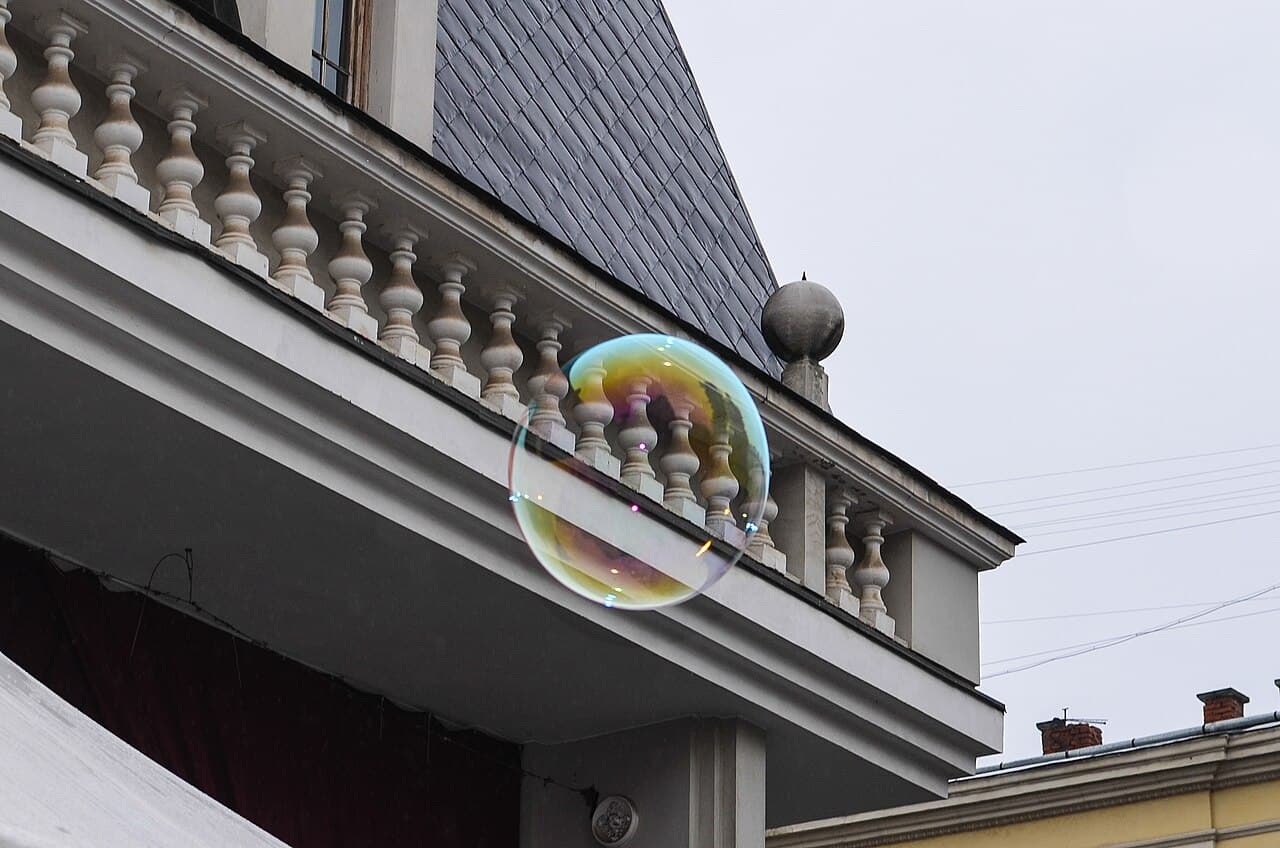
Nature doesn't need proofs; it just settles into the efficient shape on its own. A water drop forms a round shape because surface tension pulls it into whatever form minimizes surface area for the amount of water it holds, and that shape is a sphere, the 3D version of the same isoperimetric rule that makes the circle supreme in two dimensions.
Quiz me
0/3
Recap
Among all closed shapes with the same perimeter, the circle always encloses the largest area; in three dimensions, the sphere does the same for volume, which is why water drops round themselves off.
Surprising fact · Legendary queen Dido is said to have cut an oxhide into strips to encircle an entire hill, solving a version of the isoperimetric problem a couple of thousand years before it was formally proven.
Sources (3)
No source, no claim. Every fact in this lesson (10 claims) cites at least one of these.