What is pi, and why do its digits never end?
Pi is just how many times a circle's diameter fits around its edge, yet no fraction can ever pin it down exactly.
▶ Start the storyPi is the number of times a circle's diameter fits around its circumference: about 3.14159. Take any circle, a coin, a plate, a running track, and divide the distance around it by the distance across it. You always get the same number, and that number is pi.
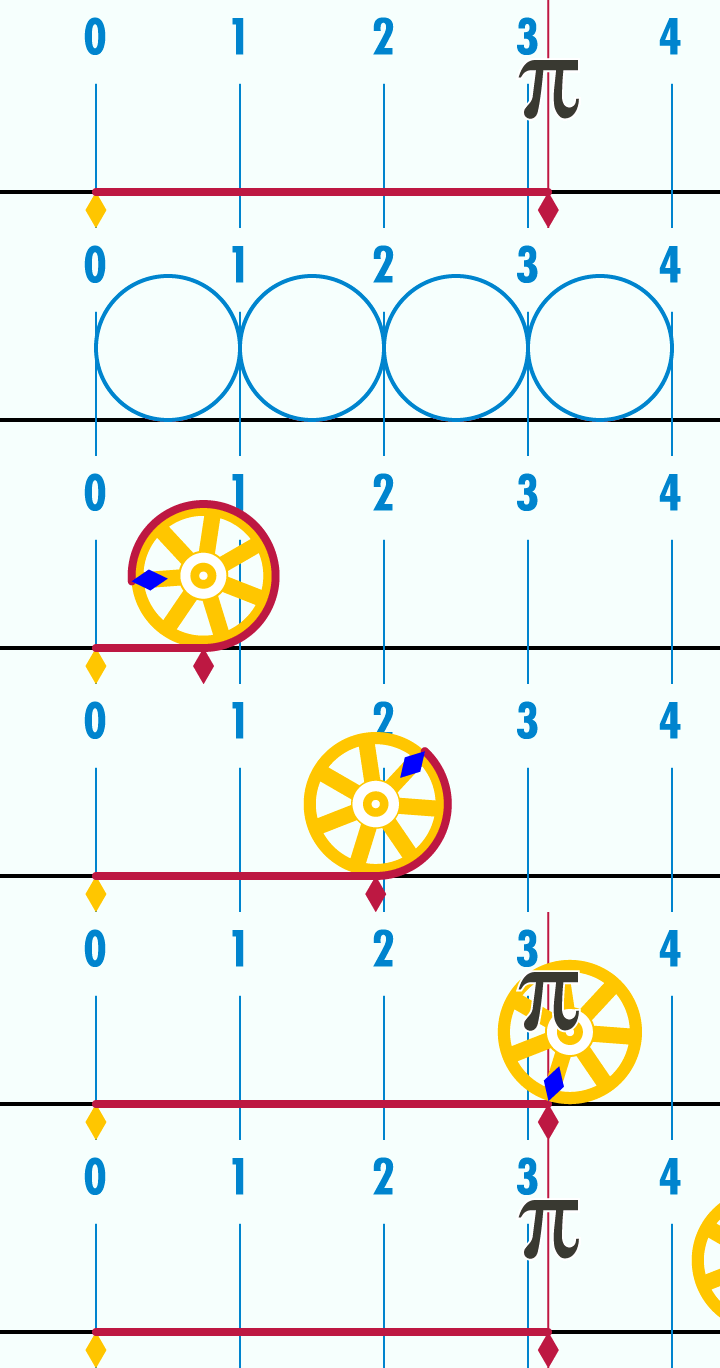
Its digits never end because pi is irrational: it can't be written as one whole number divided by another. Fractions like 22/7 or 355/113 come close, but none is exact. As a result, its decimal digits go on forever and never fall into a repeating pattern.
People have chased those digits for about 4,000 years. A Babylonian clay tablet treats pi as 3.125. Around 250 BC, Archimedes squeezed it between two polygons and proved it lies between 223/71 and 22/7. In December 2025, computers reached 314 trillion digits.
The funny part is how few we need. Just 62 decimal places are enough to calculate the circumference of the entire observable universe to within less than the smallest measurable length. The rest is pure curiosity, and a good excuse for Pi Day on March 14.
1900–1600 BCE
Babylonian tablet treats pi as 3.125
c. 250 BC
Archimedes proves 223/71 < pi < 22/7
5th century AD
Chinese mathematicians reach seven digits
1853
William Shanks computes 607 digits by hand, with an error at the 528th
1897
Indiana bill implying pi = 3.2 passes the House
2025
Computers reach 314 trillion digits
Quiz me
0/3
Recap
Pi is circumference divided by diameter, and since no fraction equals it, its digits never end or repeat.
Surprising fact · In 1897, a bill implying pi equals 3.2 passed Indiana's House without a vote against.
Sources (4)
No source, no claim. Every fact in this lesson (16 claims) cites at least one of these.