Why did German money become worthless in 1923?
A loaf of bread that cost 160 marks at the end of 1922 cost 200 billion marks a year later.
▶ Start the storyGerman money became worthless because the government kept paying its bills by printing more of it, until people lost all faith in the mark. The trouble began with the First World War. Rather than raise taxes, Germany borrowed to pay for the war, assuming it would win and make the losers pay. It lost instead, and the young Weimar Republic inherited a debt of 156 billion marks.
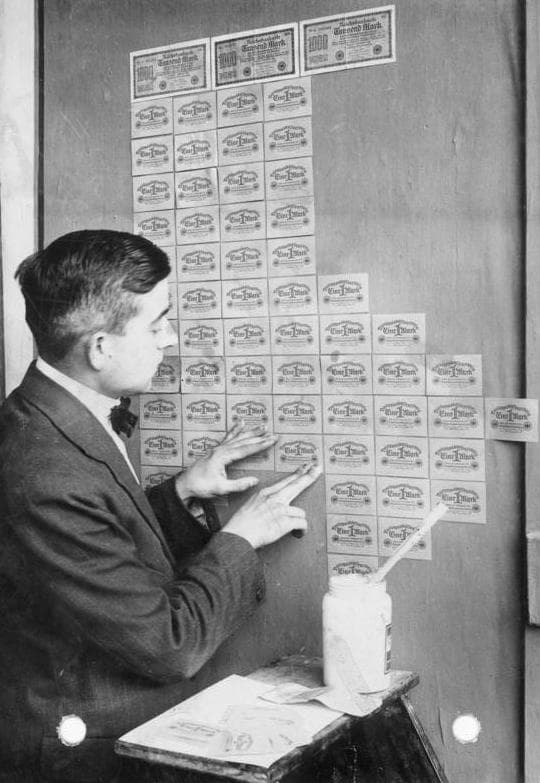
The mark slid, then collapsed. It went from 4.2 per dollar in 1914 to 7,400 per dollar by December 1922. In January 1923 French and Belgian troops occupied the Ruhr, Germany's industrial heartland, after Germany kept missing coal deliveries owed as war reparations. The government backed striking workers there by printing ever more banknotes, and historians broadly agree this fed the fire. Once people realised their money was melting, they rushed to spend it, which pushed prices up even faster in a vicious cycle.
By November 1923 one dollar was worth 4.2 trillion marks, and a loaf of bread in Berlin that had cost 160 marks at the end of 1922 cost 200 billion. The fix was a new currency, the Rentenmark, introduced on 16 November 1923, which cut twelve zeros off prices. How much blame the reparations deserve is still debated, since very little cash was actually paid during the crisis.
Quiz me
0/3
Recap
Paying bills with freshly printed money makes each note worth less, and once people rush to spend, prices spiral out of control.
Surprising fact · A loaf of bread in Berlin went from about 160 marks at the end of 1922 to 200 billion marks by late 1923.
Sources (1)
No source, no claim. Every fact in this lesson (16 claims) cites at least one of these.