Why did the oldest surviving photograph take days to expose?
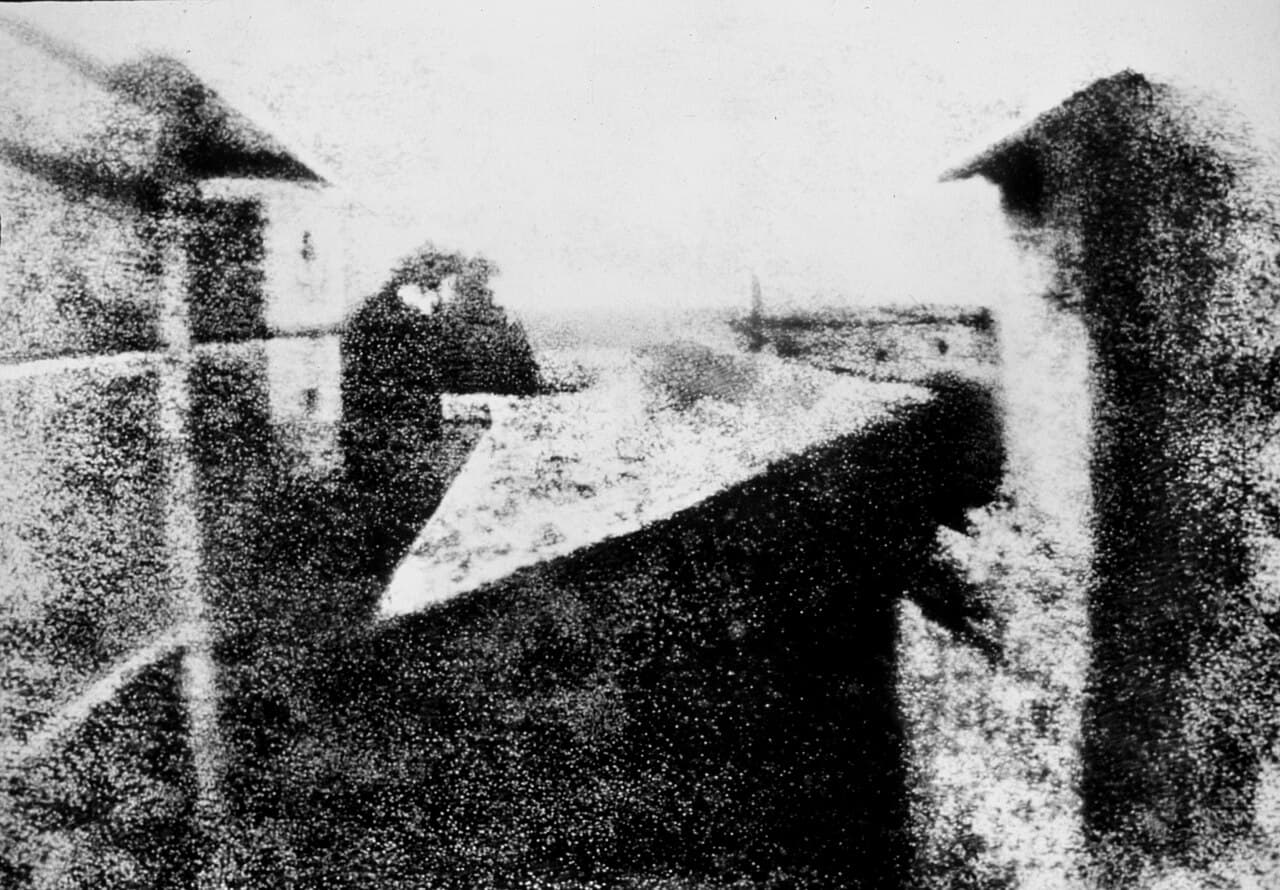
A French aristocrat left a pewter plate coated with tar in a camera aimed out of his window, and simply waited. The oldest surviving camera photograph needed not seconds, not minutes, but probably days of light to form.
▶ Start the storyBecause the light-sensitive coating it used reacted extremely slowly. Around 1826 or 1827, Nicéphore Niépce coated a polished sheet of pewter with bitumen, a natural petroleum tar, dissolved in lavender oil, and left it in a camera aimed out of a window at Le Gras. Light gradually hardened the bitumen in proportion to how much fell on each spot. Only after a very long exposure, traditionally said to be eight hours but now believed to be several days, was it hard enough for the unhardened parts to be washed away with a solvent, leaving a positive image. Nobody yet knew how to bring out a faint image afterwards, so the light had to do all the work.
Photography needed two old ideas brought together: the camera obscura, which projects an image, and the discovery that some substances are visibly altered by light. Niépce, a French aristocrat, scientist and chemist whose family fortune let him pursue inventions, had already tried paper coated with silver chloride in 1816. It did capture camera images, but as negatives that darkened all over as soon as they were exposed to light for viewing. Bitumen was slow, but its image stayed. The result, View from the Window at Le Gras, is very crude, and it is the oldest surviving photograph of an image formed in a camera.
Niépce died suddenly in 1833, leaving his notes to his associate Louis Daguerre. Daguerre, more interested in silver than in tar, found that a much shorter exposure on an iodine-fumed silver plate left an invisible "latent" image that mercury fumes could develop to full visibility. That brought exposure times down to a few minutes under good conditions. The daguerreotype was announced at the French Academy of Sciences on 7 January 1839, with complete instructions made public that August, and it became the first publicly announced, commercially viable photographic process.
Quiz me
0/3
Recap
Photography began as an endurance test measured in days before a chemical trick with mercury fumes brought exposure times down to minutes.
Surprising fact · The world's oldest surviving camera photograph needed days, not seconds, of sunlight to form on its pewter plate.
Connects to
- 🎙️ How much of the movie that ended the silent era was actually talking?
- 🎩 Why did cinema's great special-effects pioneer end up selling toys at a train station?
- 🚂 Did the first movie audiences really run from a train on the screen?
- 🌈 Why do old Technicolor films look more colourful than real life?
- 📷 Why does a tiny hole in a dark room show the world upside down?
Sources (1)
No source, no claim. Every fact in this lesson (10 claims) cites at least one of these.