How thick would Earth's ozone layer be if you squashed it flat?
All the ozone shielding life on Earth, compressed to sea-level pressure, would form a layer just 3 millimeters thick — and it was discovered because some sunlight simply didn't show up.
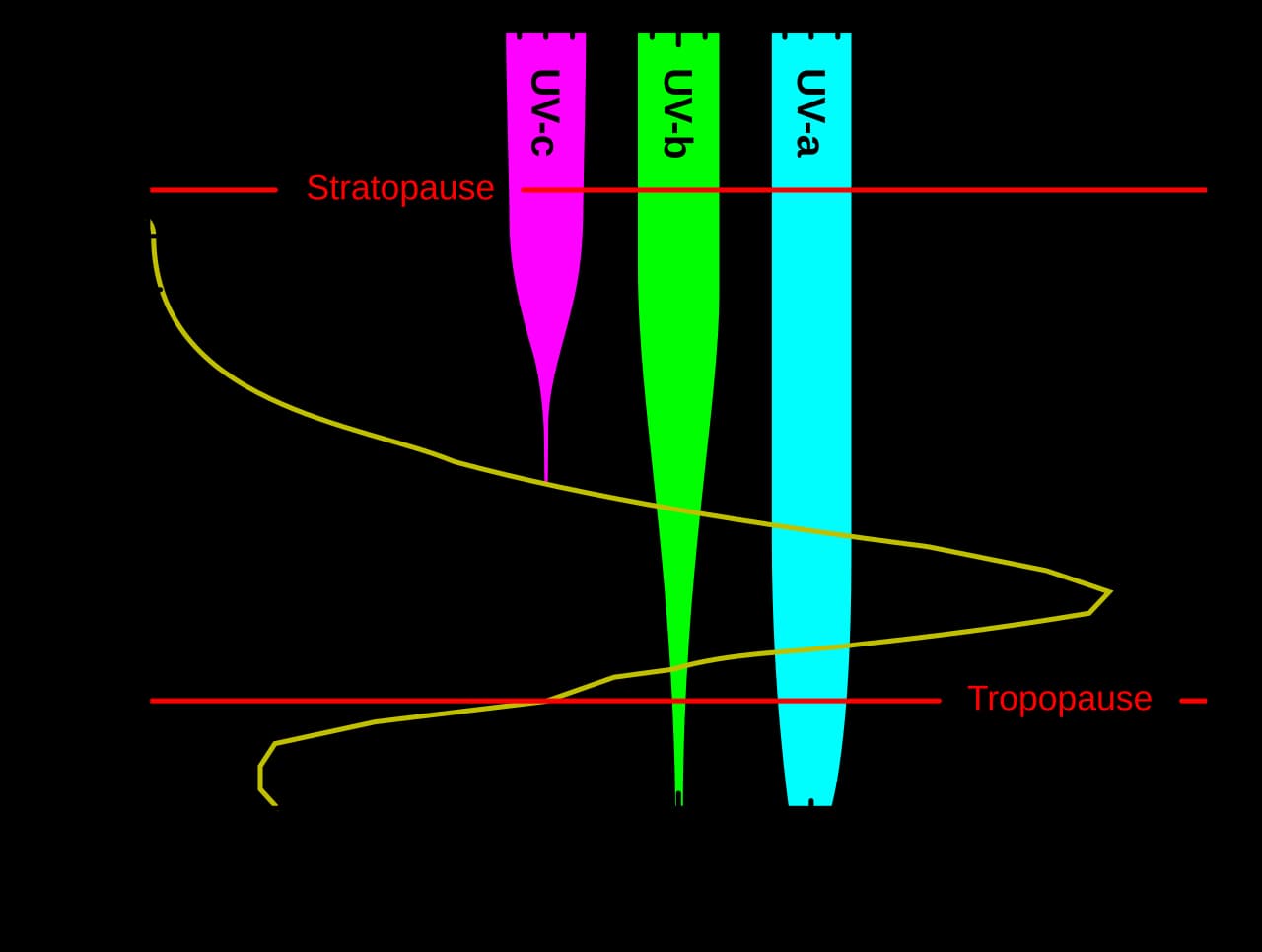
▶ Start the storyTake every ozone molecule in Earth's atmosphere and squeeze it down to the same pressure as air at sea level, and you'd get a layer just 3 millimeters thick — about the thickness of a couple of stacked coins. That impossibly thin shell, sitting 15 to 35 kilometers up in the stratosphere, absorbs 97 to 99% of the Sun's medium-frequency ultraviolet light before it ever reaches the ground.
Nobody set out to find it. In 1913, French physicists Charles Fabry and Henri Buisson were measuring sunlight reaching the ground and comparing it to the Sun's expected spectrum. Below a certain wavelength in the ultraviolet, the light simply wasn't there — something in the atmosphere was swallowing it whole. When they matched the shape of that missing light to a known chemical, there was only one match: ozone.
British meteorologist G. M. B. Dobson then built a ground-based instrument, the Dobsonmeter, to measure how much ozone sat overhead, and between 1928 and 1958 he set up a worldwide network of monitoring stations that's still running today. The unit used to measure atmospheric ozone, the Dobson unit, carries his name.
The ozone itself is made and unmade constantly: ultraviolet light splits ordinary two-atom oxygen molecules apart, and the loose atoms combine with intact oxygen molecules to form ozone, a cycle worked out by physicist Sydney Chapman in 1930. The layer itself is ancient, forming around 500 million years ago once oxygen built up to roughly a fifth of the atmosphere — and Earth isn't alone in having one: Venus carries a much thinner ozone layer of its own, 100 kilometers up. A very different chapter began in 1985, when researchers found that industrial chemicals were depleting Earth's layer — a story of its own.
Step 1: UV hits O2
Ultraviolet light splits an ordinary oxygen molecule into two single atoms
Step 2: O + O2 → O3
A loose oxygen atom combines with an intact O2 molecule to form ozone
Step 3: UV hits O3
Ultraviolet light splits ozone back into O2 and a free oxygen atom
Quiz me
0/3
Recap
The ozone layer was discovered not by finding something new, but by noticing a specific color of sunlight that was missing.
Surprising fact · Compressed to sea-level pressure, all of Earth's ozone would form a layer only 3 millimeters thick.
Sources (1)
No source, no claim. Every fact in this lesson (12 claims) cites at least one of these.