How did a declaration that isn't a law become the world's most translated document?
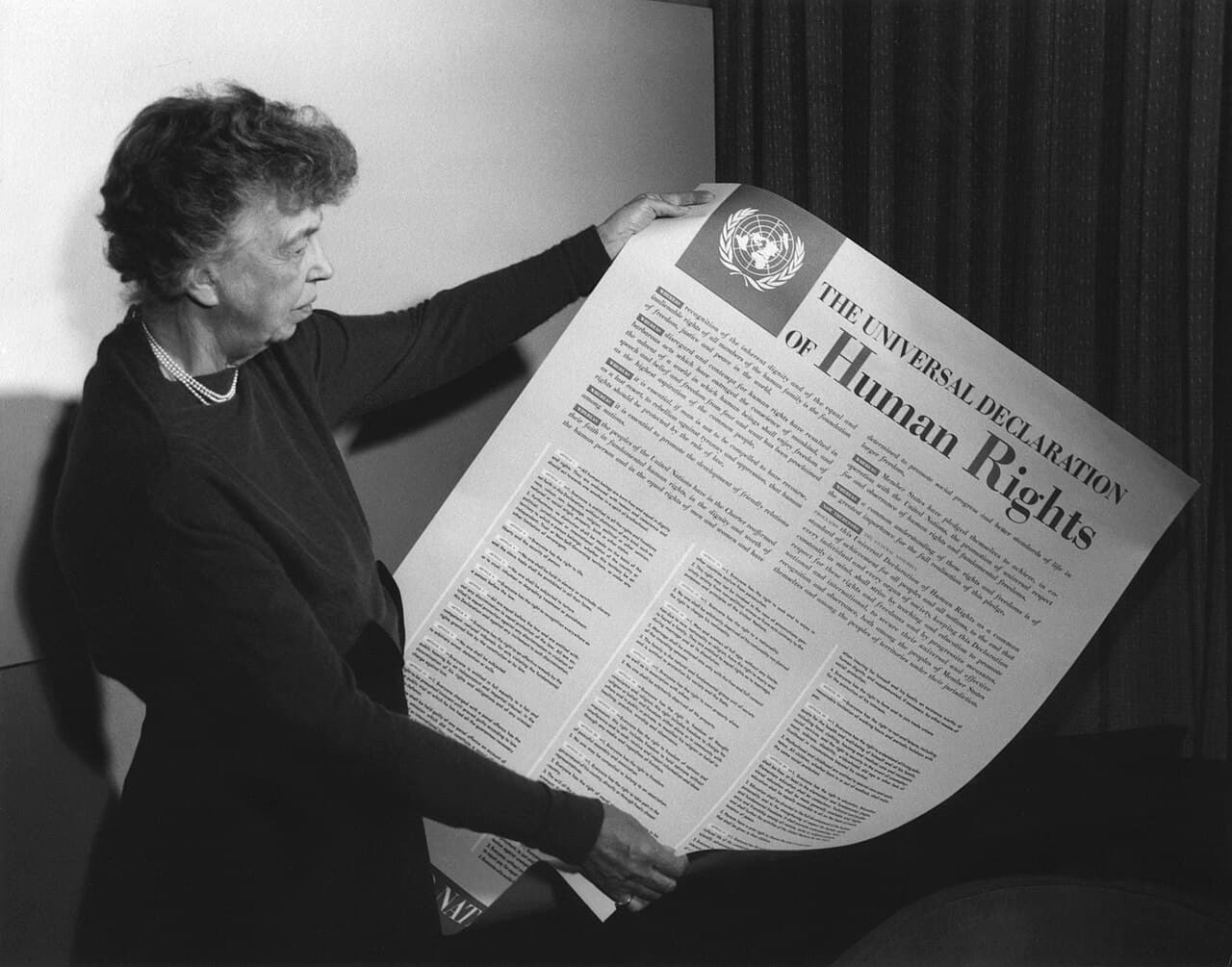
Eleanor Roosevelt insisted it was "not a treaty". Yet the 1948 Universal Declaration of Human Rights has been translated into hundreds of languages and shaped most constitutions written since.
▶ Start the storyThe Universal Declaration of Human Rights became the world's reference point precisely because it wasn't a binding law. Adopted by the United Nations in Paris on 10 December 1948, it set out 30 articles of rights for everyone, "born free and equal in dignity and rights", whatever their nationality, sex, colour, religion or language. Eleanor Roosevelt, who chaired the drafting committee, told the assembly it was "not a treaty": a statement of principles, a common standard to aim for. Because it asked for agreement on ideals rather than legal obligations, 48 countries could vote for it and none against, and its ideas then flowed into later treaties and national constitutions.
It was a team effort across cultures. The Canadian lawyer John Peters Humphrey drew up the blueprint, and the French jurist René Cassin wrote the first draft. China's P. C. Chang and Lebanon's Charles Malik were also leading drafters. Cassin had been gravely wounded in the First World War and had joined de Gaulle in London in 1940; he later won the Nobel Peace Prize for this work.
The debates were real. South Africa's delegate fought to remove the word "dignity", rightly fearing it would be used against apartheid. Saudi Arabia abstained over the right to change religion and equal marriage rights, and six communist states abstained too.
Roosevelt hoped the text would do for the world what the Declaration of Independence had done for the United States. In one sense it did: it is now the most translated document on Earth, available in 562 languages by 2024.
Quiz me
0/3
Recap
It was deliberately a declaration, not a treaty: a bet on shared ideals over legal force.
Surprising fact · Its French drafter René Cassin pictured it as a Greek temple, with a foundation, steps, four columns and a pediment.
Sources (2)
No source, no claim. Every fact in this lesson (26 claims) cites at least one of these.