How can a tardigrade survive outer space?
A micro-animal living in the moss on your roof can dry itself into a husk, ride into space, and wake up with a drop of water.
▶ Start the storyA tardigrade survives space by, in a sense, switching life off. When the moss or pond it lives in dries out, this tiny eight-legged animal pulls in its legs and shrivels into a dried-up husk called a tun. Inside, no metabolic activity takes place at all, a state biologists call cryptobiosis. It can stay like that for several years without food or water, and when water returns, it comes back to life as it was.
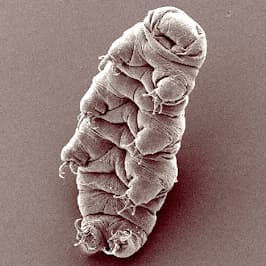
As a tun, a tardigrade shrugs off conditions that would kill almost anything else: temperatures from −272 °C to +149 °C, at least briefly, no oxygen, vacuum, radiation and crushing pressure. So in 2007, scientists sent dried tardigrades into orbit on the FOTON-M3 mission for ten days. The vacuum of space alone had no significant effect on them. What hurt was the Sun's ultraviolet light: combined with vacuum it killed many tuns, and full solar ultraviolet left only three survivors of one species.
How do they do it? Not with the sugar trehalose, as long believed; they don't make enough of it. Instead, drying tardigrades produce special floppy, "disordered" proteins that may set into a glass-like material that protects their cells. A protein called Dsup shields their DNA from radiation.
One honest caveat: tardigrades are not true extremophiles. They don't thrive in these conditions; they only endure them, and the longer they're exposed, the more likely they are to die.
Quiz me
0/3
Recap
Tardigrades don't thrive in extreme conditions: they switch life off and wait them out.
Surprising fact · In orbit, vacuum alone barely affected them; solar ultraviolet was what killed most.
Sources (2)
No source, no claim. Every fact in this lesson (16 claims) cites at least one of these.