How did a microbe from a Yellowstone hot spring make PCR possible?
Scientists once thought no bacteria could live above about 55 °C. One that thrives far hotter turned out to carry the enzyme that rescued PCR, the DNA-copying method.
▶ Start the storyBy supplying an enzyme that survives the heat PCR needs. PCR copies a piece of DNA in rounds, and after each round the mixture must be heated above 90 °C to pull the new strands apart. That heat inactivated the enzyme first used, the Klenow fragment from E. coli bacteria. Taq polymerase, from the hot-spring bacterium Thermus aquaticus, withstands the 95 °C needed without falling apart, so it replaced it.
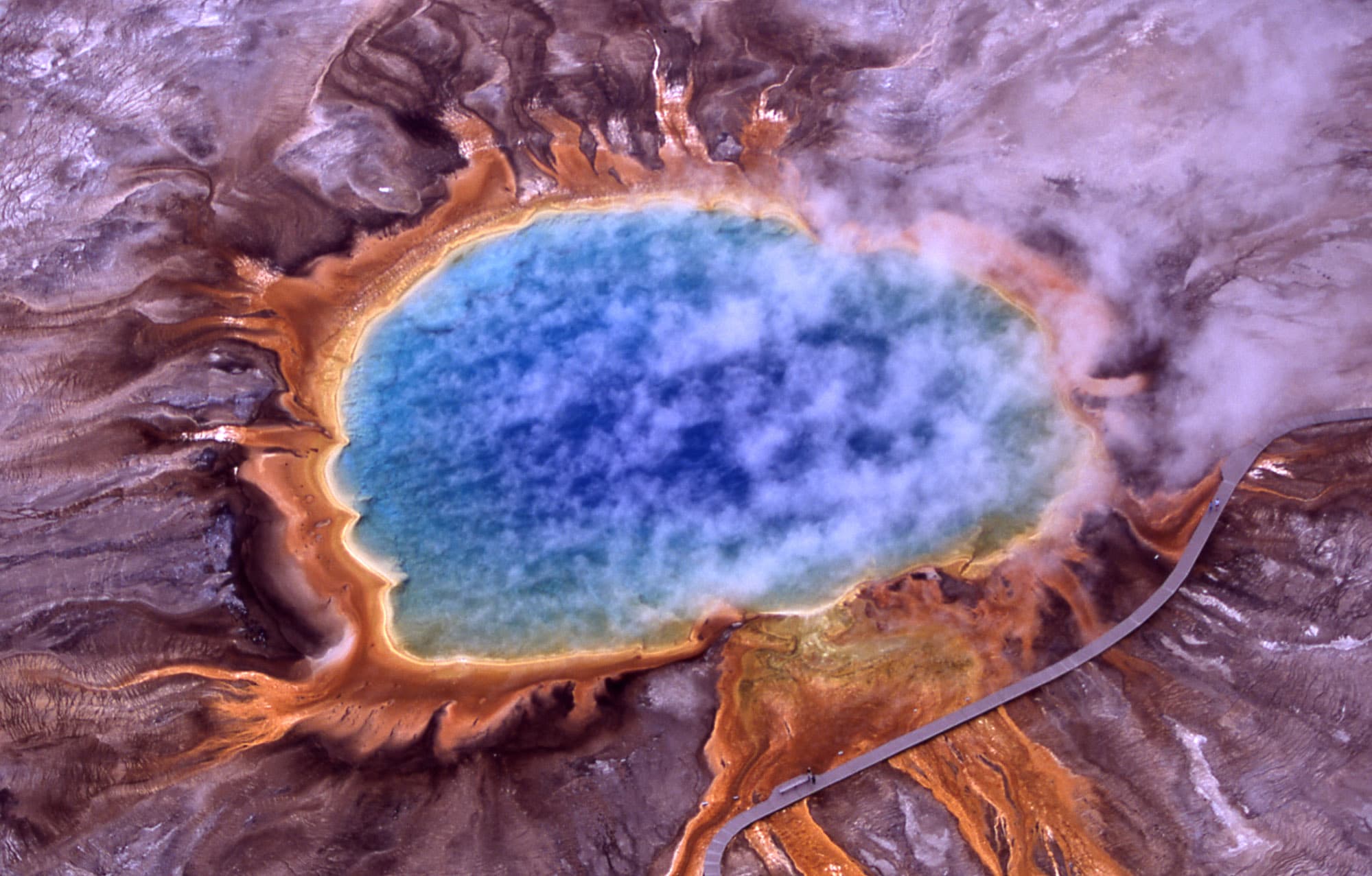
Its discovery overturned an assumption. When hot-spring biology began in the 1960s, scientists thought thermophilic bacteria could not live above about 55 °C, until they found bacteria thriving in hotter springs. In 1969, Thomas D. Brock and Hudson Freeze of Indiana University described one from Mushroom Spring in Yellowstone National Park and named it Thermus aquaticus, Latin for 'hot water'. It grows best at 65 to 70 °C and survives up to 80 °C, which makes it an extremophile: an organism that thrives in extreme conditions, not one that merely endures them.
In 1983, Kary Mullis at Cetus Corporation came up with PCR itself, using two short DNA primers and a polymerase to copy a target segment exponentially, work that earned him the Nobel Prize in Chemistry in 1993. Taq made the method practical, and in 1989 Science named it its first 'Molecule of the Year'.
The money is its own story. Cetus gave Mullis $10,000, then sold the PCR patents to Roche for some $300 million (one account says $330 million), leaving Mullis feeling cheated for the rest of his life. Roche's PCR-related sales reached $5.4 billion in 2022, yet Yellowstone, the National Park Service and Wyoming have never received a share.
Quiz me
0/3
Recap
A true extremophile thrives in extreme conditions rather than merely surviving them, which is why a thermophile's heat-stable proteins can power tools like PCR.
Surprising fact · Despite PCR-related sales reaching billions of dollars a year, Yellowstone National Park and Wyoming have never received a share of the profits from the bacterium found in their hot springs.
Sources (3)
No source, no claim. Every fact in this lesson (19 claims) cites at least one of these.