How loud was Krakatoa, the loudest sound in history?
In 1883 a volcano in Indonesia was heard 4,800 km away, and its shock wave went round the planet three and a half times.
▶ Start the storyKrakatoa was loud enough to be heard on the other side of an ocean. At 10:02 a.m. on 27 August 1883, the third explosion of the Indonesian volcano produced the loudest sound known in history. People heard it 3,110 km away in Perth, Australia, and 4,800 km away on the island of Rodrigues, near Mauritius, where they assumed a ship somewhere nearby was firing its cannon. The sound took nearly four hours to get there.
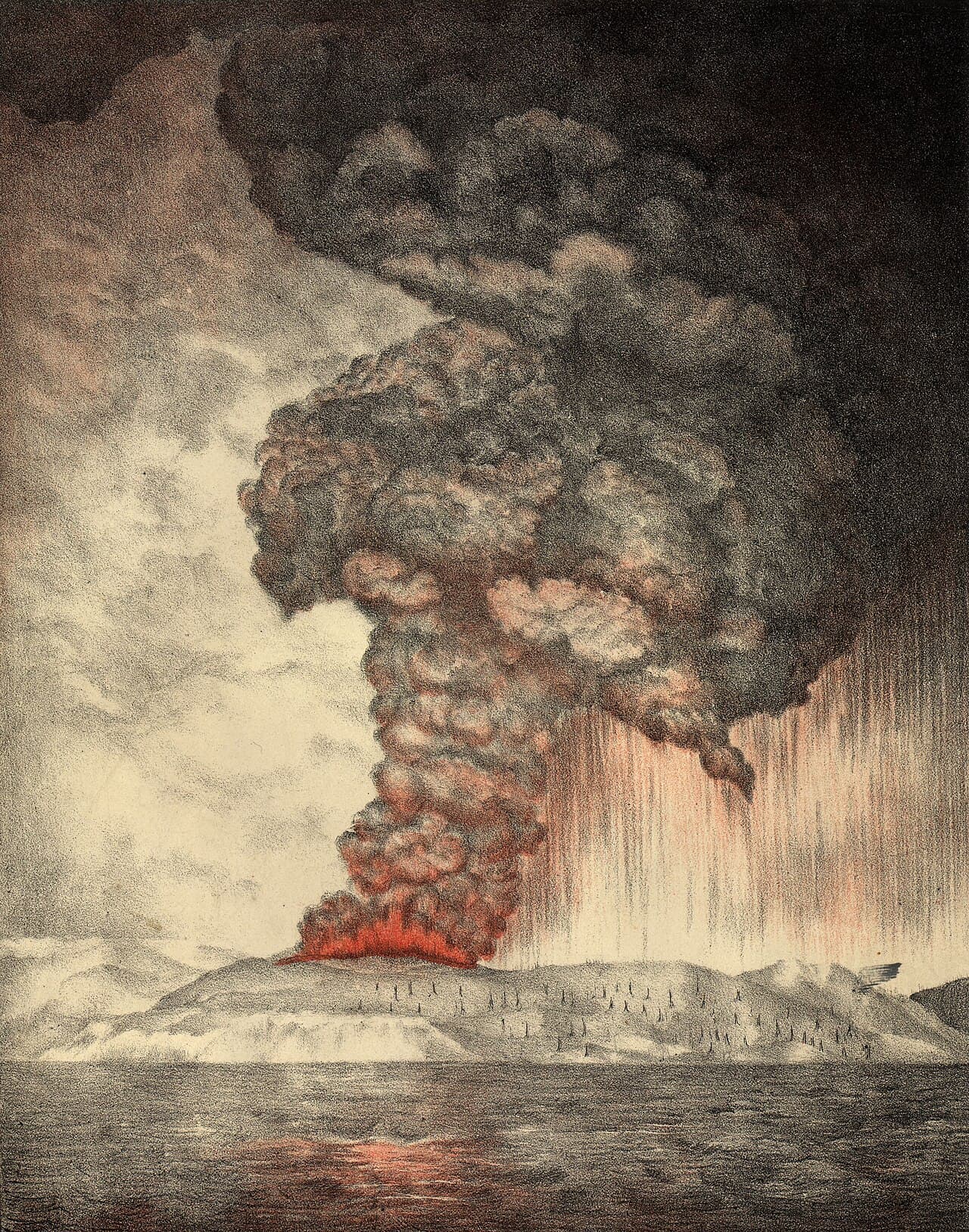
Closer in, it was not a sound so much as a blow. Sixty-four kilometres away, sailors on the ship Norham Castle had their eardrums ruptured. In Batavia, today's Jakarta, 160 km away, the air wave burst windows, cracked walls and sent a gasworks pressure gauge off its scale. Scientists later calculated that the blast was still 180 decibels at that distance.
The pressure wave did not stop at the horizon. Barometers all over the world registered a little jump as it passed, and some registered it seven times over five days as the wave raced to the far side of the planet and back. In total, it went around the globe three and a half times.
The roar came with a terrible toll: the eruption destroyed most of the island, raised tsunamis up to 46 metres high and officially killed 36,417 people.
Quiz me
0/3
Recap
Sound is a pressure wave: Krakatoa's was strong enough to break eardrums 64 km away and still register on barometers after several laps of the Earth.
Surprising fact · Sailors 64 km away had their eardrums burst, while some people right next to the volcano barely heard the biggest blasts.
Sources (2)
No source, no claim. Every fact in this lesson (16 claims) cites at least one of these.