Why are sunsets red and orange?
In 1883 the sunsets over New York were so red that firefighters rushed out to put out a fire that wasn't there.
▶ Start the storySunsets are red and orange because, when the Sun is low, its light has to cross far more air to reach you, and the air strips the blue out along the way. Sunlight is a mix of all the colours. The tiny nitrogen and oxygen molecules in the air scatter short blue and green waves much more strongly than long red ones, knocking them out of the direct beam. At noon the light takes a short path down through the atmosphere, so plenty of every colour survives. At sunset the path is so long that the blue and green are removed almost completely, and what reaches your eyes is the leftover orange and red.
That reddened light then bounces off clouds and larger particles, painting the whole horizon. Evening air usually holds more particles than morning air, which is why sunsets tend to be more brilliant than sunrises.
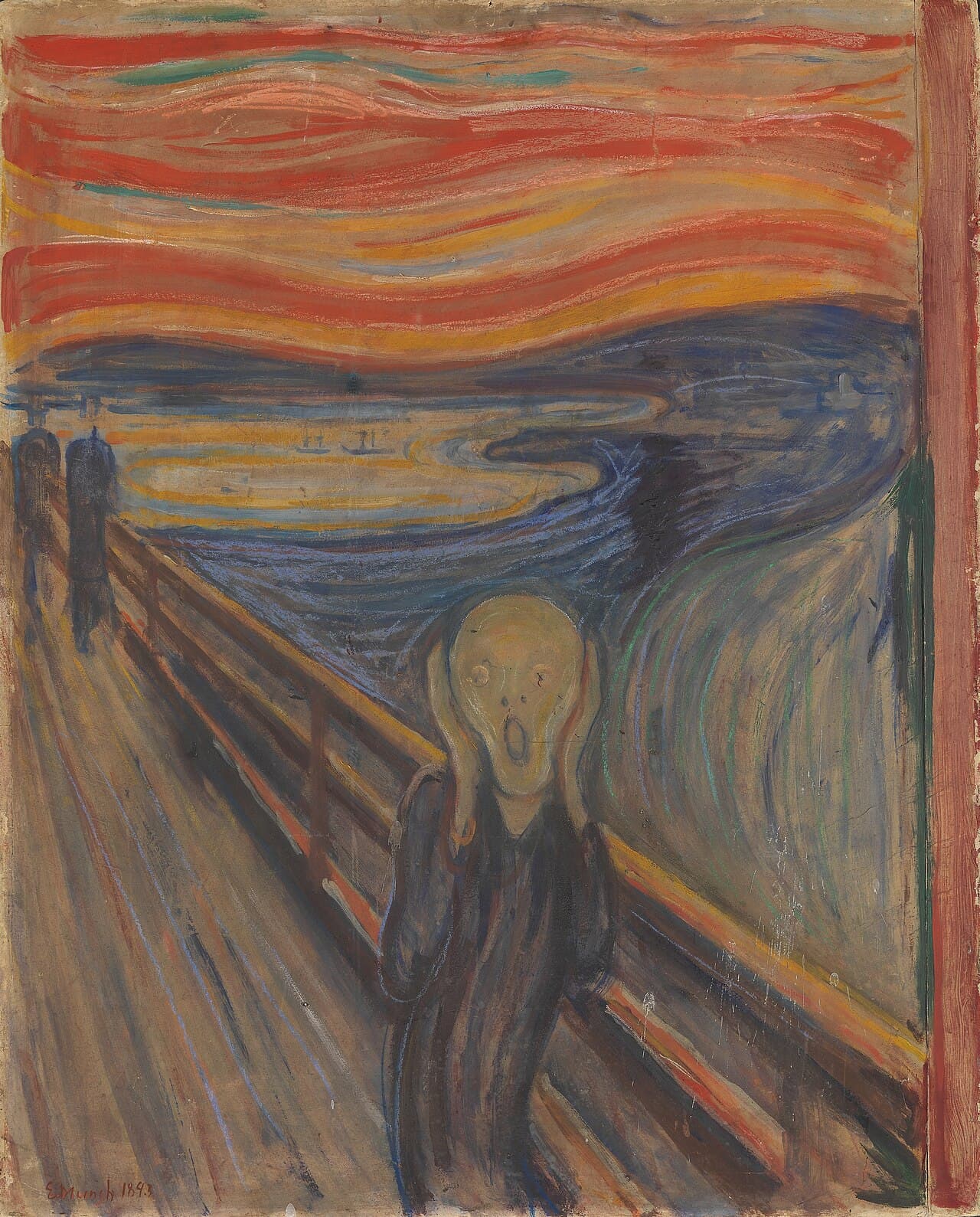
Add more particles high in the sky and sunsets can become astonishing. After the volcano Krakatoa erupted in 1883, its haze produced spectacular sunsets around the world for months. In New York, Poughkeepsie and New Haven, the evening sky glowed so red that fire engines were called out to fight a blaze that turned out to be the sunset.
Noon
- Sun high overhead
- Short path through the air
- Plenty of every colour survives
Sunset
- Sun low on the horizon
- Much longer path through the air
- Blue and green removed almost completely
- Orange and red remain
Quiz me
0/3
Recap
Long path, less blue: the lower the Sun, the redder the light that reaches you.
Surprising fact · Mars has the opposite effect: its sunsets are blue.
Sources (3)
No source, no claim. Every fact in this lesson (13 claims) cites at least one of these.