How did cartoons get real depth decades before 3D existed?
A German silhouette animator built an early version with layers of glass in 1923. A former Disney animator later built a better one partly from parts of an old Chevrolet.
▶ Start the storyWatch Snow White and the Seven Dwarfs, especially the moment the Evil Queen drinks her potion and the room seems to spin around her, and you're seeing a trick that predates computer graphics by decades: the multiplane camera, a motion-picture camera that moves pieces of artwork past the lens at different speeds and distances, creating a sense of parallax or depth. Painted backgrounds, middle layers, and foreground elements all move independently under a single downward-facing camera, with layers further away moving slower, the same way distant hills seem to crawl past a car window while roadside signs flash by.
The idea wasn't born in Hollywood. An early version of the multiplane camera was developed by the German silhouette animator Lotte Reiniger and her husband Carl Koch for her 1926 feature The Adventures of Prince Achmed, using multiple layers of glass as early as 1923 to add depth to her flat paper-cutout figures, with the camera fixed in place above the stacked artwork. A few years later, the animator Ub Iwerks, working independently after leaving Walt Disney Studios, built his own improved version partly out of salvaged parts from an old Chevrolet automobile, while Fleischer Studios built a related device using tiny three-dimensional miniature sets instead of flat glass layers.
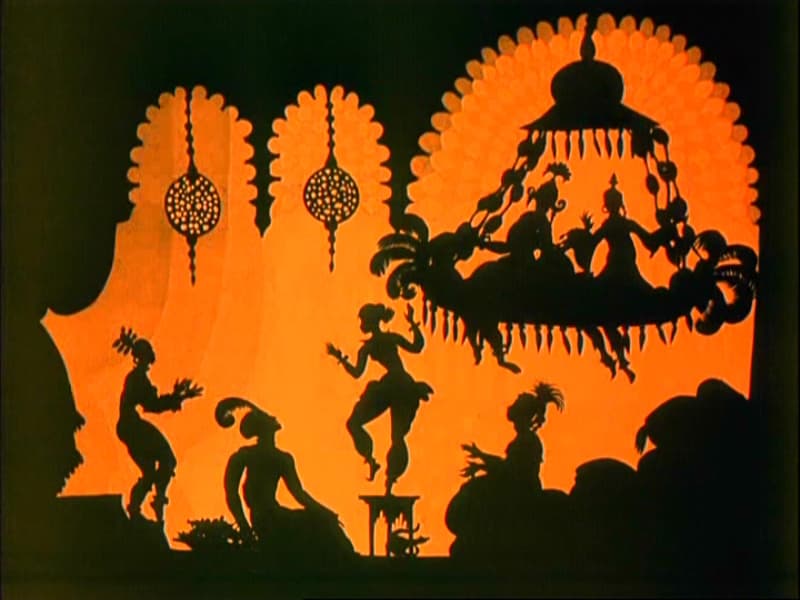
Disney's own engineers eventually built the most elaborate version, completed in 1937 and first tested on the short film The Old Mill, which promptly won an Academy Award. Disney's camera stacked up to seven layers of artwork, painted in oils directly on sheets of glass, under a massive vertical camera rig that sometimes needed a dozen technicians just to operate and advance each layer between shots.
The payoff was a problem animators had struggled with for years: before the multiplane camera, it was difficult to create a convincing tracking shot that kept perspective consistent, and animating that kind of forward motion by hand was becoming increasingly costly and slow. The multiplane camera gave cartoons a believable sense of three-dimensional space using nothing but painted glass, stacked physical layers, and patience, and it shaped the look of Disney classics from Pinocchio and Bambi to Sleeping Beauty, right up until The Little Mermaid, the last Disney film to use a physical version before a digital version took over the job.
Quiz me
0/3
Recap
Before computers, animators faked 3D depth by physically stacking painted glass layers and moving each one at its own speed under the camera.
Surprising fact · Disney's version used up to seven layers of glass painted in oils and sometimes needed a dozen technicians to operate for a single scene.
Connects to
Sources (1)
No source, no claim. Every fact in this lesson (14 claims) cites at least one of these.