Did gladiators really fight to the death?
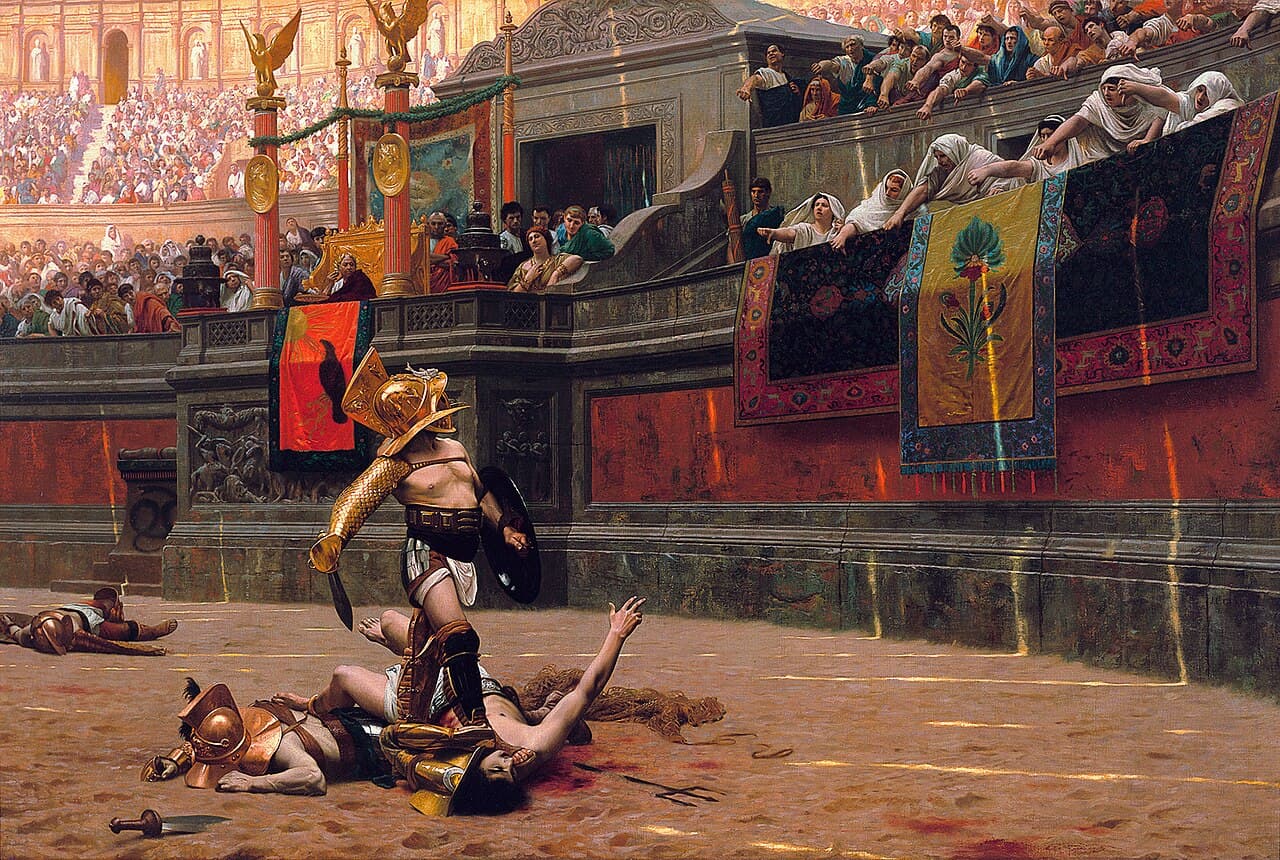
A famous 1872 painting of a crowd giving the 'thumbs down' shaped how we picture gladiator fights. Skeletons from a real gladiator graveyard tell a very different story.
▶ Start the storyUsually not. Most fights seem to have ended with both fighters still alive. A trained gladiator was expensive to raise, feed and house, so his owner had every financial reason to keep him alive for the next show. Fights were refereed, sometimes paused for rest, and could be stopped before anyone died.
That doesn't mean it was safe. Using 1st-century gravestones, the historian George Ville estimated that about 19 of every 100 men who entered the arena died there. The average gladiator died at 27. The odds also got worse over time: a defeated gladiator's risk of death rose from about 1 in 5 to 1 in 4. A beaten fighter could raise a finger to ask for the fight to stop. The final call on his life belonged to the sponsor of the games, who usually followed the crowd's reaction. He gave it with a gesture called pollice verso, 'with a turned thumb'.
19 of 100
Here's the twist: nobody today actually knows what that gesture looked like. Ancient writers never describe it clearly enough to say whether the thumb pointed up, down, sideways, or was hidden inside a fist. The 'thumbs down means death' idea that feels so obviously Roman was made famous by one French painting, Pollice Verso, by Jean-Léon Gérôme in 1872. It was hugely popular, and films borrowed it, right up to the 2000 movie Gladiator.
Some of the best evidence comes from the bodies themselves. Roman writers say a beaten gladiator should die well, offering his neck to the final blow. Gladiator remains from a cemetery at Ephesus, in today's Turkey, confirm it. In a gladiators' cemetery, some skulls, but not all, show a probably fatal blow from a mallet. Real violence, then, but also real rules.
Quiz me
0/3
Recap
Gladiators were valuable property, trained and fed to survive and refereed in matches; a beaten one was killed only when the sponsor of the games, usually following the crowd, decided it.
Surprising fact · No ancient source describes the 'thumbs down' gesture clearly enough to reconstruct it; the idea was popularized by an 1872 painting, not Roman texts.
Sources (3)
No source, no claim. Every fact in this lesson (14 claims) cites at least one of these.