What did a volcano freeze in time about everyday Roman life?
In 79 AD, Mount Vesuvius buried a Roman town so completely that its bread ovens, snack bars and even a dog's final moments survived almost two thousand years.
▶ Start the storyAn ordinary town's daily life: its bakeries, its snack bars, the scribbles on its walls, and its people in their final moments. In 79 AD, Mount Vesuvius erupted, hurling ash and rock 33 kilometres into the sky and burying the town of Pompeii under up to six metres of volcanic debris. More than 1,500 bodies have been found there and at the nearby town of Herculaneum, out of a combined population over 20,000, though the exact death toll is still unknown.
What makes Pompeii extraordinary isn't the disaster itself. It's what the ash preserved underneath it. Bodies and wooden objects rotted away over the centuries, leaving human-shaped cavities in the hardened ash. In the 1860s, Giuseppe Fiorelli, the archaeologist running the dig, realised he could pour plaster into those cavities. When the ash around it was cleared away, out came a plaster cast of a person at the exact moment they died: crouching, covering their face, clutching a loved one.
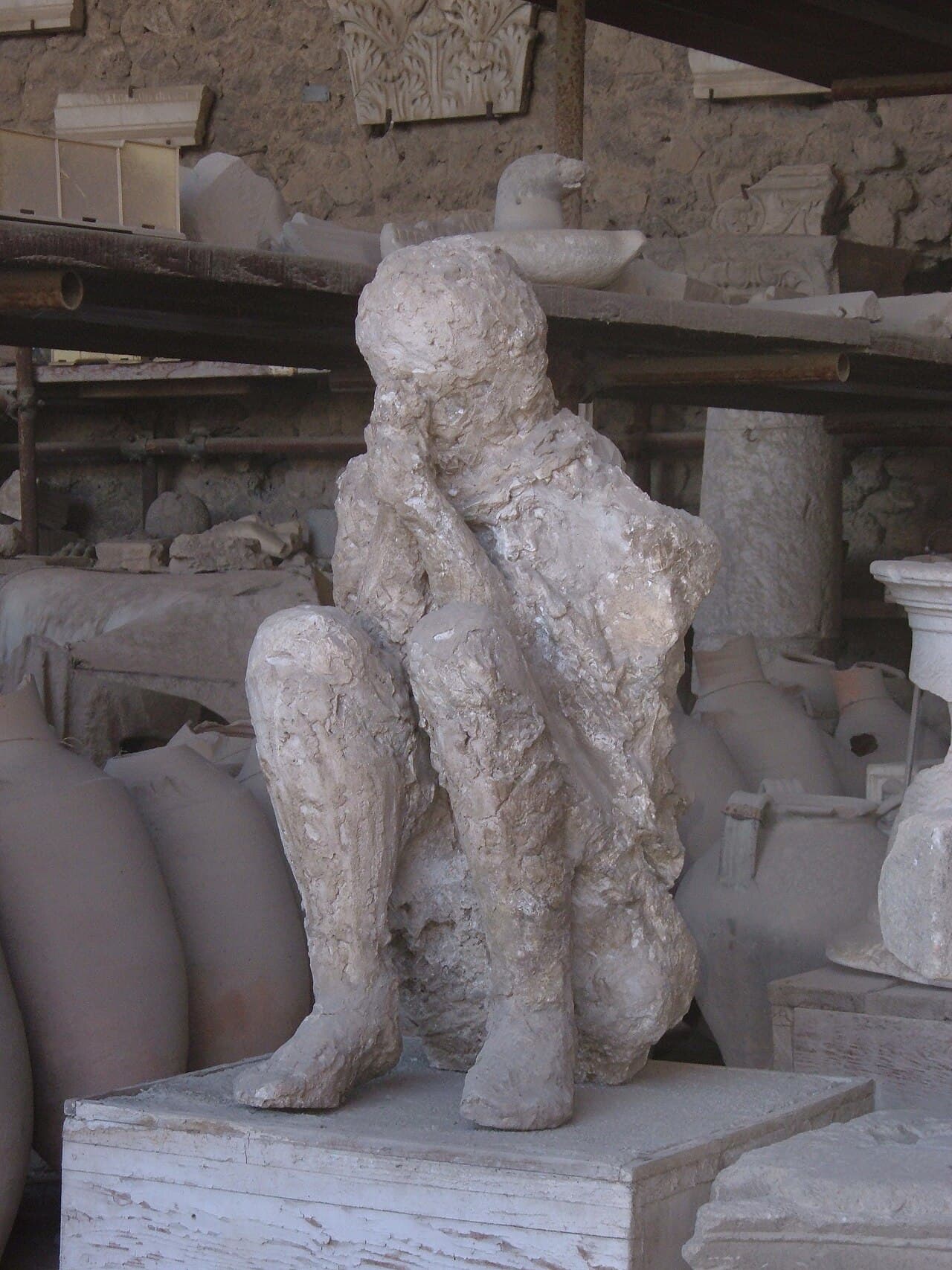
Fiorelli changed more than casting. Before him, diggers cleared the streets first, then went into houses from the ground floor up. He flipped the method, uncovering buildings from the top down, which preserved far more of what was found.
What survived shows a surprisingly familiar town. Pompeii had at least 31 bakeries with their own ovens and sales counters, and nearly 100 snack-bars selling hot food, one of which still held jars of duck, goat, pig, fish and snails when it was dug up in 2020. Graffiti scratched into walls everywhere capture how ordinary Romans actually talked, a far cry from the polished Latin of literature. And an eyewitness account survives too: Pliny the Younger watched the eruption from across the bay and wrote it all down in two letters.
Quiz me
0/3
Recap
The famous body-shaped casts of Pompeii's victims exist because an archaeologist, Fiorelli, realised he could pour plaster into the cavities their decayed bodies left behind.
Surprising fact · A snack-bar excavated in 2020 still held jars of duck, goat, pig, fish and snails from the day Vesuvius erupted.
Sources (3)
No source, no claim. Every fact in this lesson (16 claims) cites at least one of these.