Are there bacteria living inside every one of your cells?
The tiny power stations in your cells still carry their own DNA, their own ribosomes and their own dialect of the genetic code. Two billion years ago, they were free-living bacteria.
▶ Start the storyIn a sense, yes. The mitochondria that power your cells, turning food and oxygen into the energy molecule ATP, are the descendants of free-living bacteria. Somewhere around 1.7 to 2 billion years ago, a bacterium that could use oxygen was swallowed by another cell and, instead of being digested, survived inside it. The partnership worked so well that the guest became a permanent part of the host. The same thing happened again in plants: their chloroplasts descend from cyanobacteria taken in about two billion years ago. Biologists call this symbiogenesis.
The clues are still visible. Mitochondria and chloroplasts carry their own DNA, often on a single circular chromosome like a bacterium's. They multiply by splitting in two, like bacteria. Their ribosomes, the machines that build proteins, look like bacterial ribosomes rather than the ones in the rest of your cell. Human mitochondria even use their own slightly different version of the genetic code. And you inherit them only from your mother.
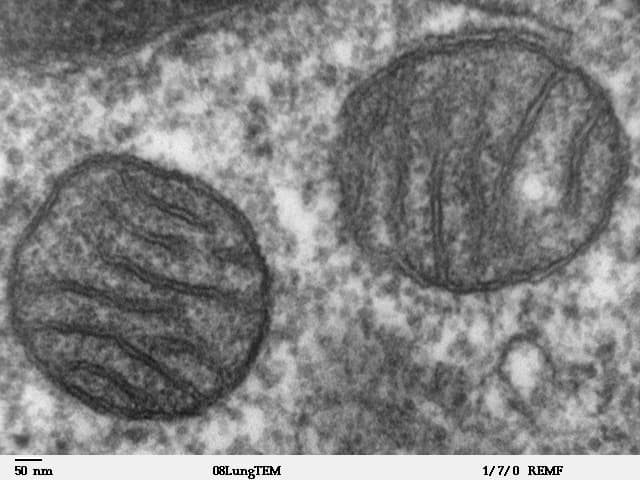
Over time the guests handed most of their genes to the host. Their bacterial relatives carry thousands of genes; human mitochondrial DNA keeps just 37.
The idea was old but scorned. A Russian botanist, Konstantin Mereschkowski, proposed it in 1905. When Lynn Margulis, a young biologist at Boston University, wrote her case for it in 1966, the paper was rejected by about fifteen journals. She was largely ignored for another decade, until genetic evidence proved her right. Today it is textbook biology, and Margulis liked to sum it up this way: life did not take over the globe by combat, but by networking.
Quiz me
0/3
Recap
Own DNA, own circular chromosome, own bacterial-type ribosomes, division by splitting: mitochondria still look like the bacteria they once were.
Surprising fact · Lynn Margulis's landmark paper on the idea was rejected by about fifteen journals before it was published in 1967.
Sources (4)
No source, no claim. Every fact in this lesson (27 claims) cites at least one of these.