Why is the Parthenon secretly curved?
Its floor bulges 10 cm in the middle and its columns lean inward. For more than 170 years, people have argued about why.
▶ Start the storyThe Parthenon is curved on purpose, but nobody knows for sure why, and the most famous explanation may be a myth. When nineteenth-century surveyors measured the temple closely, they found it is not built from straight lines. Its platform bulges upward in the middle by 10.3 centimetres over 70 metres. Its columns swell slightly and taper toward the top, a trick called entasis. The columns and walls lean slightly inward, and the corner columns are slightly out of place.
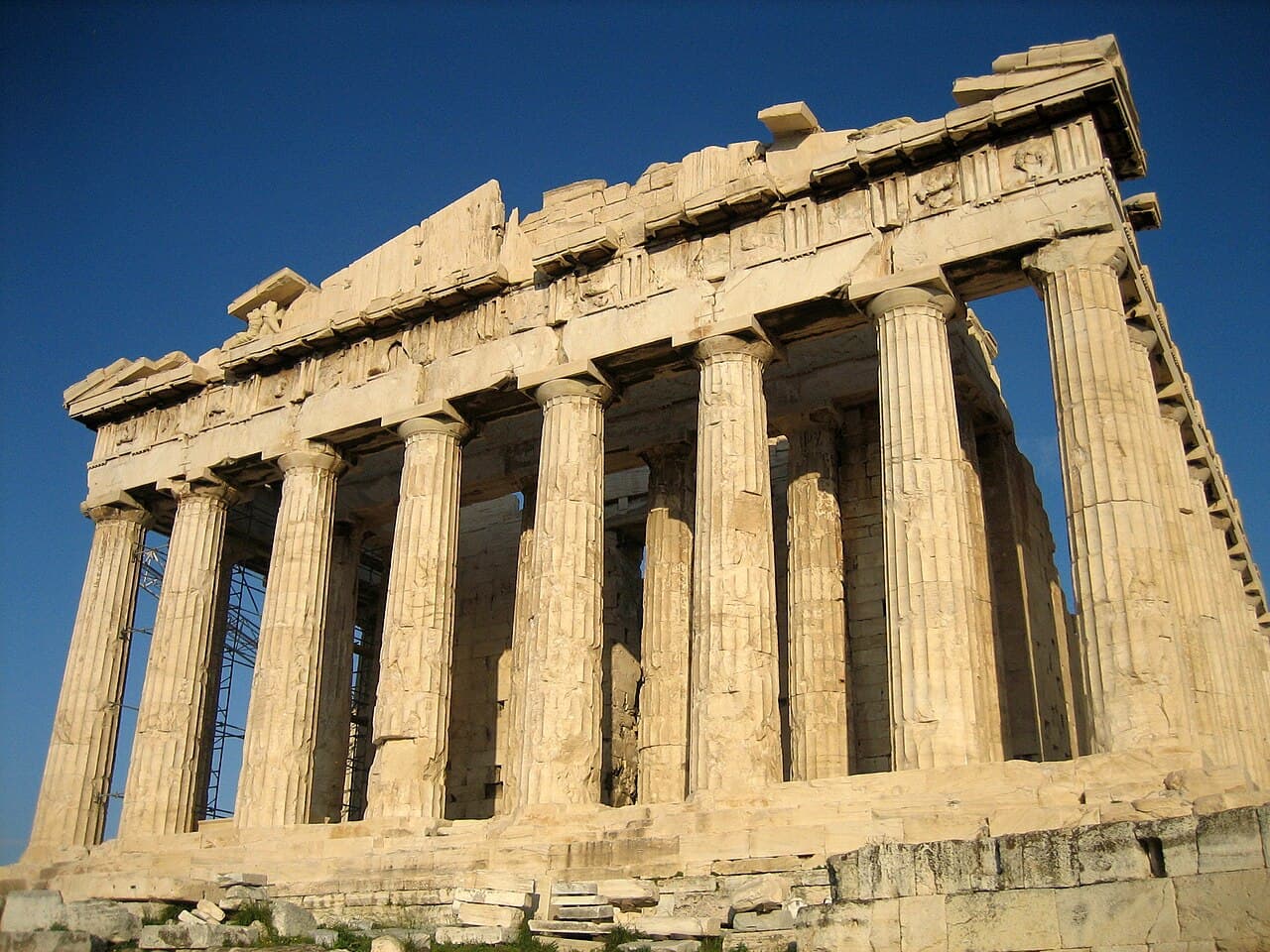
The classic explanation came from Francis Penrose in 1851: the Greeks added these convex curves to cancel out the way long straight shapes can look sagging or pinched to the human eye. It is a lovely story, and it goes back to Hero of Alexandria in ancient times. The problem is that no record of the builders' reasoning has survived; in fact, no ancient Greek text on architecture survives at all. Modern psychology experiments suggest people do not actually see the illusion entasis is supposed to fix.
So the argument goes on. Some scholars point to practical reasons, like a domed floor that sheds rainwater. Others thought the curves were simply the building settling, or were there for beauty and symbolism. One architect suggested a swelling column looks like a straining muscle, which fits the Greek root of 'entasis', meaning 'to strain'. And the Oxford mathematician Alain Goriely calls the whole idea of optical corrections one of the oldest and most enduring myths in history: real curves, he argues, but too small to notice from where we stand.
Quiz me
0/3
Recap
The curves are measured and real; the reason for them, illusion, drainage, settling or beauty, is still argued.
Surprising fact · Mathematician Alain Goriely calls the optical correction idea one of the oldest and most enduring myths in human history.
Sources (2)
No source, no claim. Every fact in this lesson (18 claims) cites at least one of these.