Why did Adam Smith say self-interest feeds a nation, not kindness?
Adam Smith's most famous line isn't about greed being good. It's about why you can count on dinner even from a stranger who doesn't care about you at all.
▶ Start the storyBecause, Adam Smith argued, you don't need anyone to be kind to you for an economy to feed you. It is not from the benevolence of the butcher, the brewer or the baker that you get your dinner, Smith wrote in 1776, but from their regard to their own interest: you appeal to their self-love, not their humanity, and talk about what's in it for them rather than what you need.
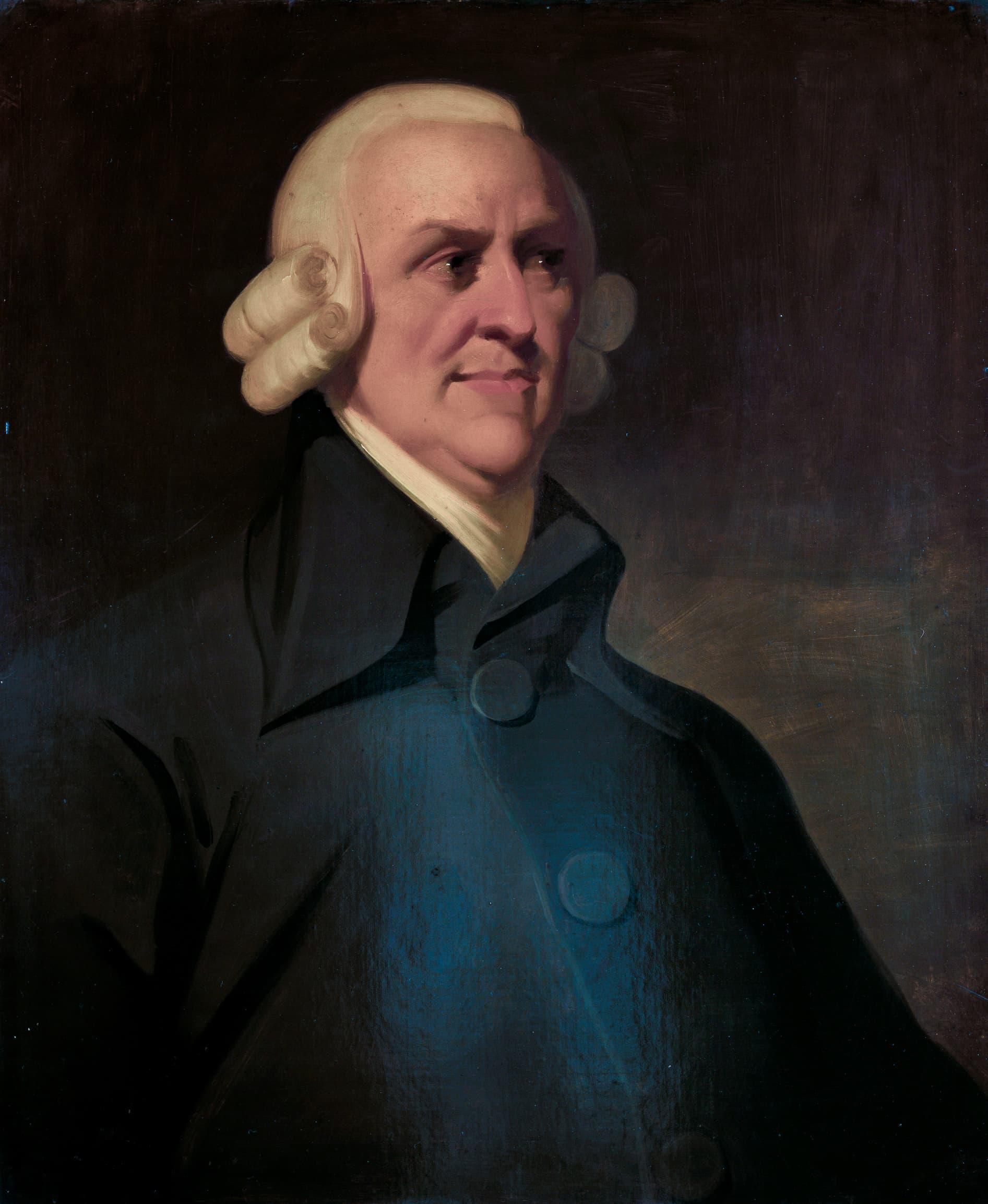
Smith, a Scottish philosopher later called the father of economics, had written an earlier book about something gentler: how even a selfish person cares about other people's happiness, if only for the pleasure of seeing it. So he didn't think humans were simply selfish machines. But in trade, he saw self-interest doing the heavy lifting. In a separate passage he described a merchant who directs his business toward the most valuable output, intending only his own gain, and who is nonetheless led by an invisible hand to promote an end which was no part of his intention.
Smith's other famous argument was about how that production gets so efficient in the first place. In the very first sentence of The Wealth of Nations, he pointed to the division of labour, the practice of breaking a job into small specialized steps, as the reason productivity could explode. His example was making pins: split among many specialized workers, pin-making vastly outproduces one person doing every step alone. Smith even argued that the gap between a street porter and a philosopher owed as much to this specialization as it caused it; people become different because the work they do shapes them.
Smith wasn't naive about any of this. He warned that businessmen could conspire to raise prices at the public's expense, and he worried that relentless, narrow specialization could leave a worker, in his own words, as stupid and ignorant as a human being can become.
Quiz me
0/3
Recap
You get your dinner not because the butcher is kind, but because the butcher wants to earn a living; that self-interest, multiplied across a specialized economy, is what Smith said actually feeds a nation.
Surprising fact · Smith, famous for the self-interest argument, also wrote that people naturally care about others' happiness for its own sake, and used the phrase 'invisible hand' only once in The Wealth of Nations.
Sources (2)
No source, no claim. Every fact in this lesson (10 claims) cites at least one of these.