Why do golf balls have dimples?
A perfectly smooth golf ball would be a worse golf ball: the pits are what make it fly.
▶ Start the storyGolf balls have dimples because those little pits make them fly farther. A ball in flight feels two aerodynamic forces, drag and lift, and dimples help with both: they cut the drag that slows the ball down, and they add to the lift that holds it up.
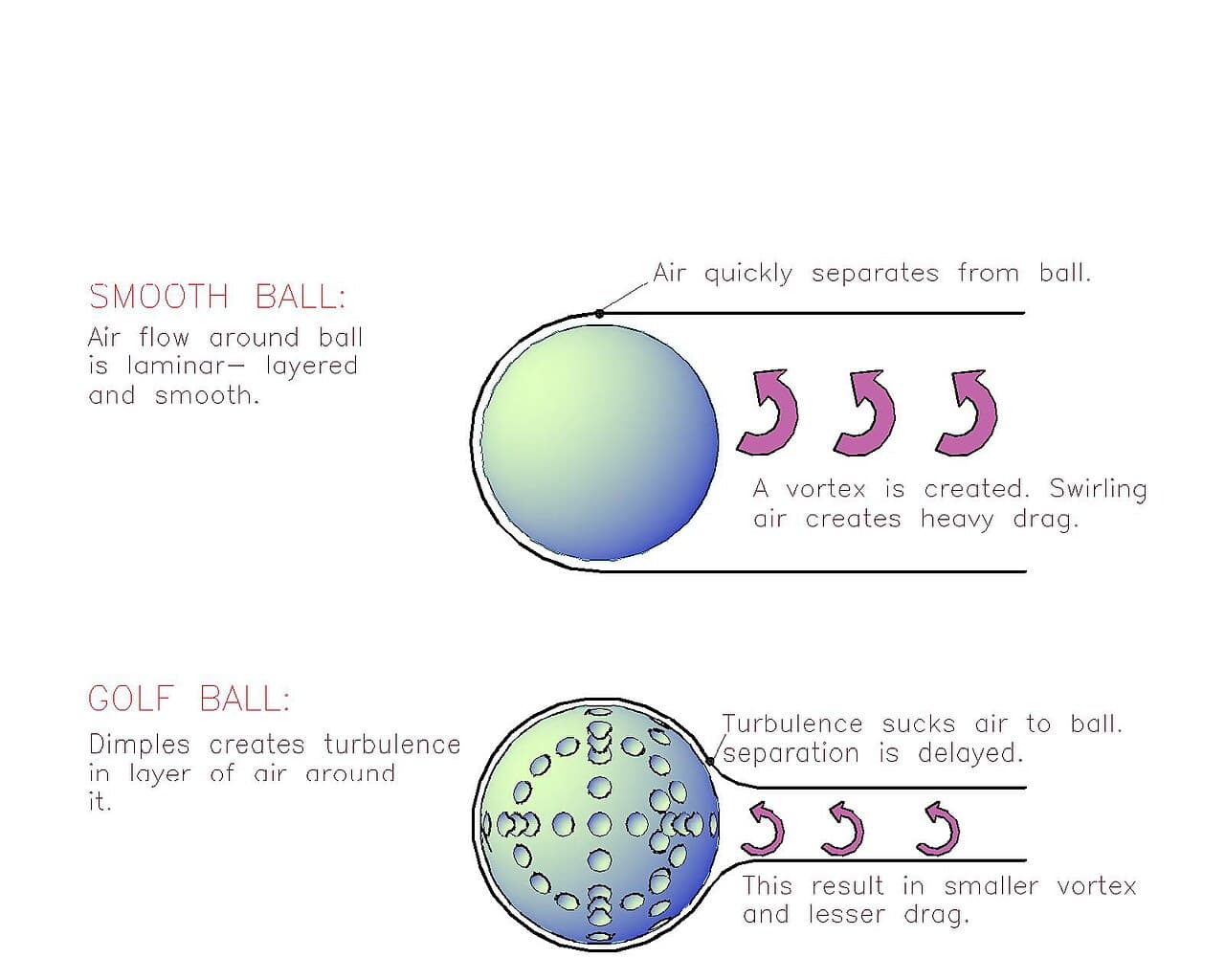
The drag part sounds backwards. Air sliding over a perfectly smooth ball lets go of the surface early, leaving a wide pocket of low pressure behind it that holds the ball back. Dimples stir up the thin skin of air hugging the ball, called the boundary layer, and make it turbulent. A turbulent layer clings to the surface much longer, so the low-pressure wake behind the ball gets narrower and the drag drops.
Step 1: Smooth ball
The layer of air on the surface lets go early and leaves a wide low-pressure wake.
Step 2: Dimples trip the air
The boundary layer turns turbulent.
Step 3: Air clings longer
The turbulent layer stays attached farther round the back.
Step 4: Narrow wake, less drag
Less pressure drag, so the ball travels farther.
The lift comes from spin. Thanks to the angled face of the club, almost every shot leaves with backspin, and a backspinning ball bends the airflow around it a bit like an aeroplane wing, which pushes it upward. That is the Magnus effect, and dimples give a ball more of it than a smooth surface would.
Nobody designed this on paper first. In the 1800s golfers noticed that their battered, nicked balls flew more reliably than smooth new ones, so ball makers started carving patterns into new balls with knives and chisels. In 1905 the English engineer William Taylor patented a regular dimple pattern. Today most balls carry somewhere between 300 and 500 dimples.
Quiz me
0/3
Recap
Rough beats smooth: a turbulent boundary layer hugs the ball longer, leaving a narrower wake and less drag.
Surprising fact · The first textured balls were smooth balls deliberately hacked with knives and chisels after golfers noticed nicked balls flew better.
Connects to
Sources (2)
No source, no claim. Every fact in this lesson (16 claims) cites at least one of these.