Why does most of India's rain fall in just a few months?
Nearly 80% of India's rain comes with one seasonal wind, from June to September, because land and ocean don't heat up at the same speed.
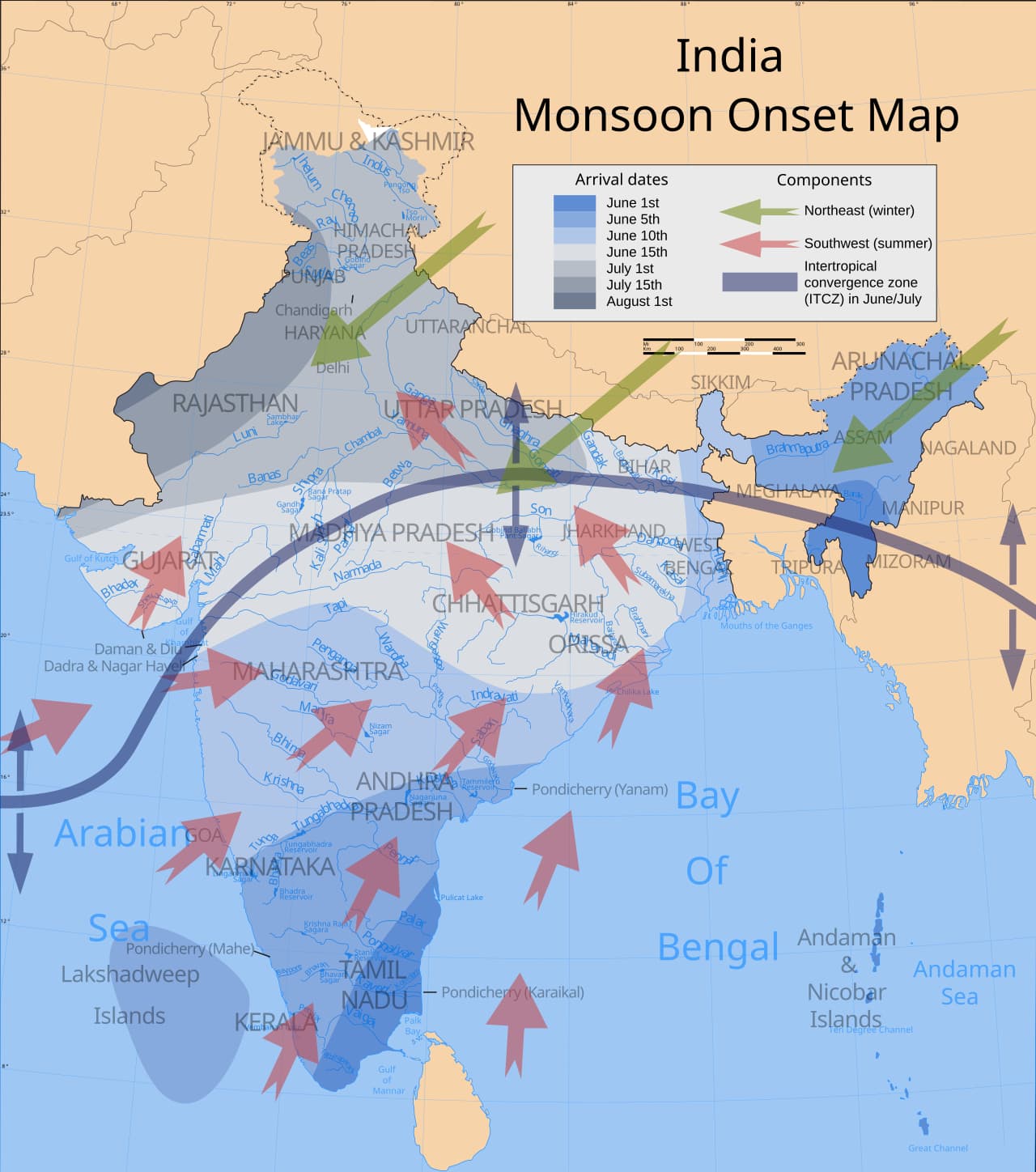
▶ Start the storyBecause India's rain arrives on a seasonal wind, the monsoon, that only blows inland for part of the year. The southwest monsoon runs from June to September, and it brings nearly 80% of the country's rainfall. It happens because land and ocean heat up at different speeds. Water has a high heat capacity and mixes heat down to depth, so the ocean's surface temperature stays fairly stable. Land heats up much faster in summer: the air above it expands, pressure drops, and moist air from the cooler, higher-pressure ocean is pulled inland. In the colder months the cycle reverses, the land cools faster than the sea, and the wind blows from land to ocean instead.
Geography squeezes the rain out. The Himalayas act like a high wall, blocking the moist winds from passing into Central Asia and forcing them to rise; as the air rises it cools and the rain falls. Some areas of the subcontinent receive up to 10,000 millimetres a year, and Mawsynram, on the southern slopes of the Khasi Hills in Meghalaya, is one of the wettest places on Earth. The word monsoon itself comes, via Portuguese and partly Dutch, from the Arabic mawsim, "season".
For India, the timing is the economy. Agriculture, about a quarter of GDP and 70% of employment, depends heavily on the rains, and a delay of just a few days can badly hurt the economy, as droughts in the 1990s showed; too much rain has costs too, as in the 2005 Mumbai flood that brought the city to a standstill. The system is ancient: its strengthening is linked to the uplift of the Tibetan Plateau after India collided with Asia, and estimates for when it became strong range from 15–20 to about 8 million years ago.
80%
Quiz me
0/3
Recap
A monsoon isn't a single storm: it's a wind system that flips direction with the seasons, because land and ocean don't heat up at the same speed.
Surprising fact · Some parts of the Indian subcontinent receive up to 10,000 millimeters of rain a year because the Himalayas force incoming moist monsoon winds to rise sharply.
Sources (1)
No source, no claim. Every fact in this lesson (15 claims) cites at least one of these.