Why did our ancestors stand up and start walking on two legs?
Footprints pressed into volcanic ash 3.7 million years ago show someone walking upright long before any of our ancestors had a big brain.
▶ Start the storyOur ancestors stood up long before they got big brains. The clearest proof is a trail of footprints at Laetoli, Tanzania. They were pressed into wet volcanic ash 3.7 million years ago. The heel strikes first, then the toes push off, just like your own stride.
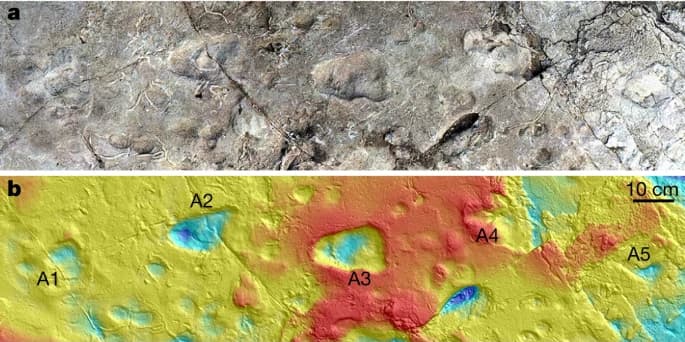
3.7 million years
The best-known early walker is Lucy, a skeleton found in Ethiopia in 1974. The team named her after a Beatles song playing at camp that night. Lucy had a small, ape-sized skull. Yet she clearly walked on two legs. So upright walking came first, and bigger brains came much later.
Why stand up at all? Nobody knows for sure. The old answer was the open savanna: standing let you see over tall grass. But Lucy still had curved fingers for climbing, and her home was wet and wooded. Other ideas compete. Walking upright frees the hands to carry food or reach fruit. It also costs about the same energy as walking on four limbs, which helps on long trips between trees.
Seeing & travelling
- See over tall grass (old savanna idea)
- Similar energy cost to four-limbed walking
- Efficient on long trips between trees
Hands free
- Reach hanging fruit (postural feeding)
- Carry food home (provisioning)
- Probably several reasons together
Most researchers now think several of these reasons worked together. Fifty years after Lucy, they also agree she was not the earliest walker. Other hominin species lived at the same time as her.
Quiz me
0/3
Recap
We stood up long before we got smart.
Surprising fact · A trail of 3.7-million-year-old footprints is clearer evidence of upright walking than any skull from the same era.
Sources (3)
No source, no claim. Every fact in this lesson (16 claims) cites at least one of these.