What would it prove if a machine passed the Turing test?
In a 2025 experiment, people picked a chatbot as 'the human' 73% of the time, more often than the real humans.
▶ Start the storyPassing the Turing test would prove that a machine can hold a conversation people can't tell from a human's, and nothing more, which is exactly the point of the debate. Alan Turing proposed the test in 1950. His paper opens with "Can machines think?", but because "thinking" is so hard to define, he swapped it for a question you can actually test: can a computer do well at an "imitation game"? A judge chats in writing with a hidden human and a hidden machine. If the judge can't reliably tell which is which, the machine passes. It doesn't need to be right, only convincingly human.
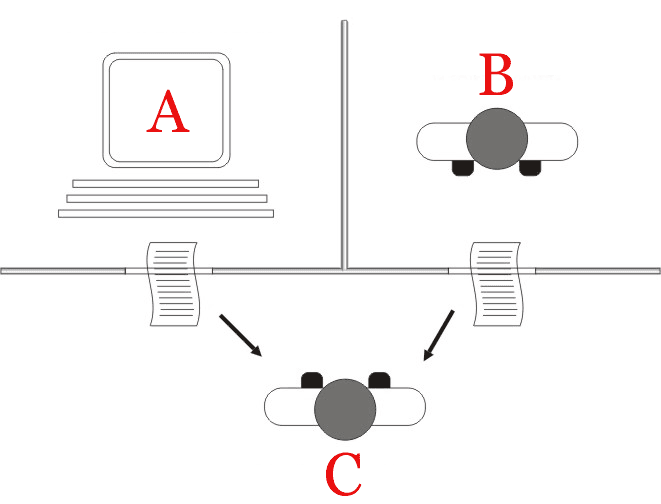
Turing based it on a party game in which guests pass written questions to a man and a woman in another room and try to work out who is who. He guessed that one day an average interrogator would have no better than a 70 percent chance of spotting the machine after five minutes.
Fooling people turned out easier than expected. In 1966, ELIZA, a simple program that bounced keywords back like a therapist, convinced some users they were talking to a person. In a 2025 experiment, GPT-4.5, told to adopt a human persona, was picked as the human 73 percent of the time, more often than the real people.
So does the machine think? The philosopher John Searle argued no: a program can pass just by shuffling symbols it doesn't understand. Passing shows imitation. Whether imitation is intelligence is still argued.
Quiz me
0/3
Recap
Passing the Turing test proves convincing imitation; whether that is understanding is a separate question.
Surprising fact · A 1966 program that just bounced keywords back, ELIZA, already fooled some people.
Connects to
- 💬 How does a large language model write a sentence, one piece at a time?
- 💡 Why might science never fully explain what it feels like to be you?
- ♾️ Why can no machine ever settle every question in mathematics?
- 🀄 Can a computer that answers perfectly in Chinese understand a word of it?
- 💭 Why was "I think, therefore I am" the one thing Descartes couldn't doubt?
Sources (1)
No source, no claim. Every fact in this lesson (19 claims) cites at least one of these.