How did a self-taught shoemaker's son invent the math behind computers?
George Boole had only a primary school education, yet the true-or-false algebra he worked out became the foundation of digital circuit design.
▶ Start the storyGeorge Boole laid the mathematical groundwork for digital circuits, and modern computer science, with nothing more than a primary school education. He was the son of a shoemaker, born in Lincoln in 1815, and he taught himself Latin and modern languages so well that a local newspaper once printed his translation of a Latin poem and a scholar accused him of plagiarism, on the pretence that he couldn't have done it himself. At 16 he was already the breadwinner for his parents and three younger siblings, teaching to support them; at 19 he opened his own school; and without ever having a calculus teacher, it took him years of solitary effort to master the subject on his own.
That self-made mathematician became, in 1849, the first professor of mathematics at Queen's College, Cork, and in 1847 he had already developed Boolean algebra, an entirely new kind of algebra where variables aren't numbers but simple truth values, true or false, written as 1 and 0. Instead of adding, subtracting, multiplying or dividing, it works with just three operations: AND, OR, and NOT. He set the idea out fully in his 1854 book The Laws of Thought, work now credited with helping lay the foundations of the Information Age.
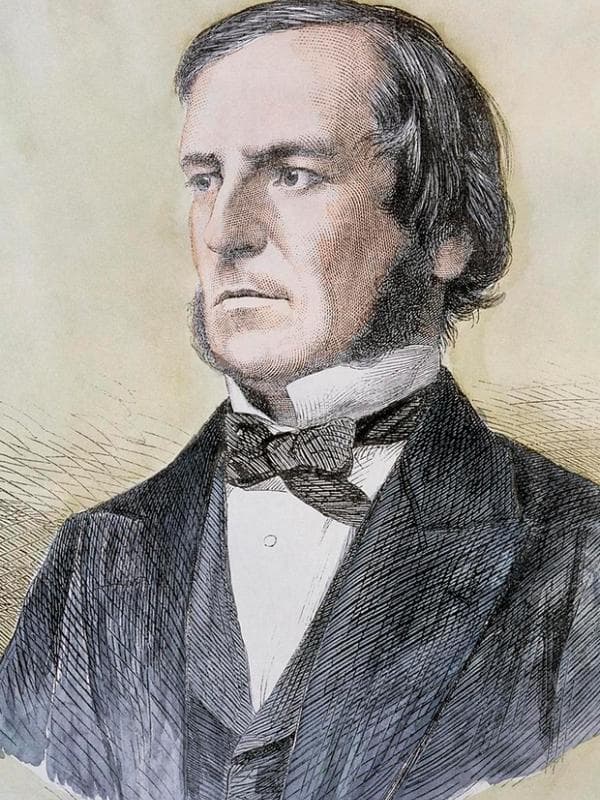
Boole didn't live to see any of that payoff. In late 1864 he walked three miles to the university through heavy rain and lectured in his soaked clothes, quickly falling ill with pneumonia. His wife, believing that a remedy should resemble the cause of the illness, wrapped him in wet blankets; his condition only worsened, and he died on 8 December 1864, at 49.
It took another seven decades for his algebra to find its practical purpose. In the 1930s, Claude Shannon, studying switching circuits, realized that the rules of Boole's algebra applied to them too. Shannon and Victor Shestakov used it to design electromechanical relay circuits, work that led to modern electronic digital computers.
Quiz me
0/3
Recap
Boolean algebra swaps numbers for true/false and arithmetic for AND, OR, and NOT.
Surprising fact · Boole, a shoemaker's self-taught son, invented the algebra in 1847, decades before anyone found a practical use for it.
Sources (2)
No source, no claim. Every fact in this lesson (18 claims) cites at least one of these.