How does a made-up word end up in the dictionary?
The word "robot" didn't exist until 1921. A Czech playwright gave it to the world, then publicly admitted the idea actually came from his brother, who built it from the Czech word for slave labor.
▶ Start the storyA brand-new word doesn't become real overnight. Linguists describe a whole pipeline for it, sometimes called the neological continuum: first a nonce word, used once and possibly never again; then a protologism, circulating only inside a small group; then a prelogism, spreading but still not mainstream; and finally a neologism, a word that's been accepted by the institutions, dictionaries, media, everyday speech, that decide what counts as "real" language.
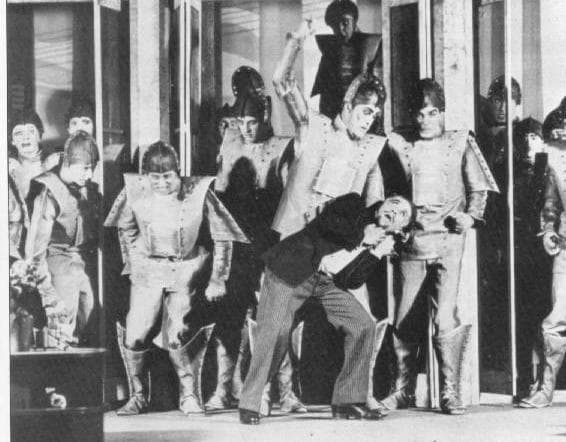
One of the most famous neologisms of the 20th century is "robot," which didn't exist before 1921, when Czech writer Karel Čapek used it in his play R.U.R. (Rossum's Universal Robots). Čapek later gave credit where it was actually due: in a newspaper article, he named his own brother Josef as the word's true inventor. Josef built it from the Czech word robota, meaning the forced labor serfs owed their masters, itself rooted in a word meaning "slave." The word went on to displace older terms like "automaton" and "android" in languages worldwide.
Not every neologism arrives through fiction. Many form by simply blending two existing words, like "brunch" from "breakfast" and "lunch," or by turning a person's name into a common word, like "boycott," from a man named Charles Boycott. Physicists have done the same thing deliberately: Murray Gell-Mann named the quark after a nonsense word from James Joyce's novel Finnegans Wake. And sometimes a brand name takes over an entire category, the way "Kleenex" came to mean any facial tissue, through nothing more than repeated use in everyday speech and mass media.
Quiz me
0/3
Recap
A word moves from nonce word to protologism to prelogism before becoming a true neologism, accepted by dictionaries and institutions; "robot," "brunch," and "boycott" all show different paths into the language.
Surprising fact · "Robot," introduced in 1921, was actually coined by playwright Karel Čapek's brother Josef, from the Czech robota, meaning forced labor derived from a word for "slave."
Sources (2)
No source, no claim. Every fact in this lesson (13 claims) cites at least one of these.