How did Roman concrete build a dome that still holds a world record?
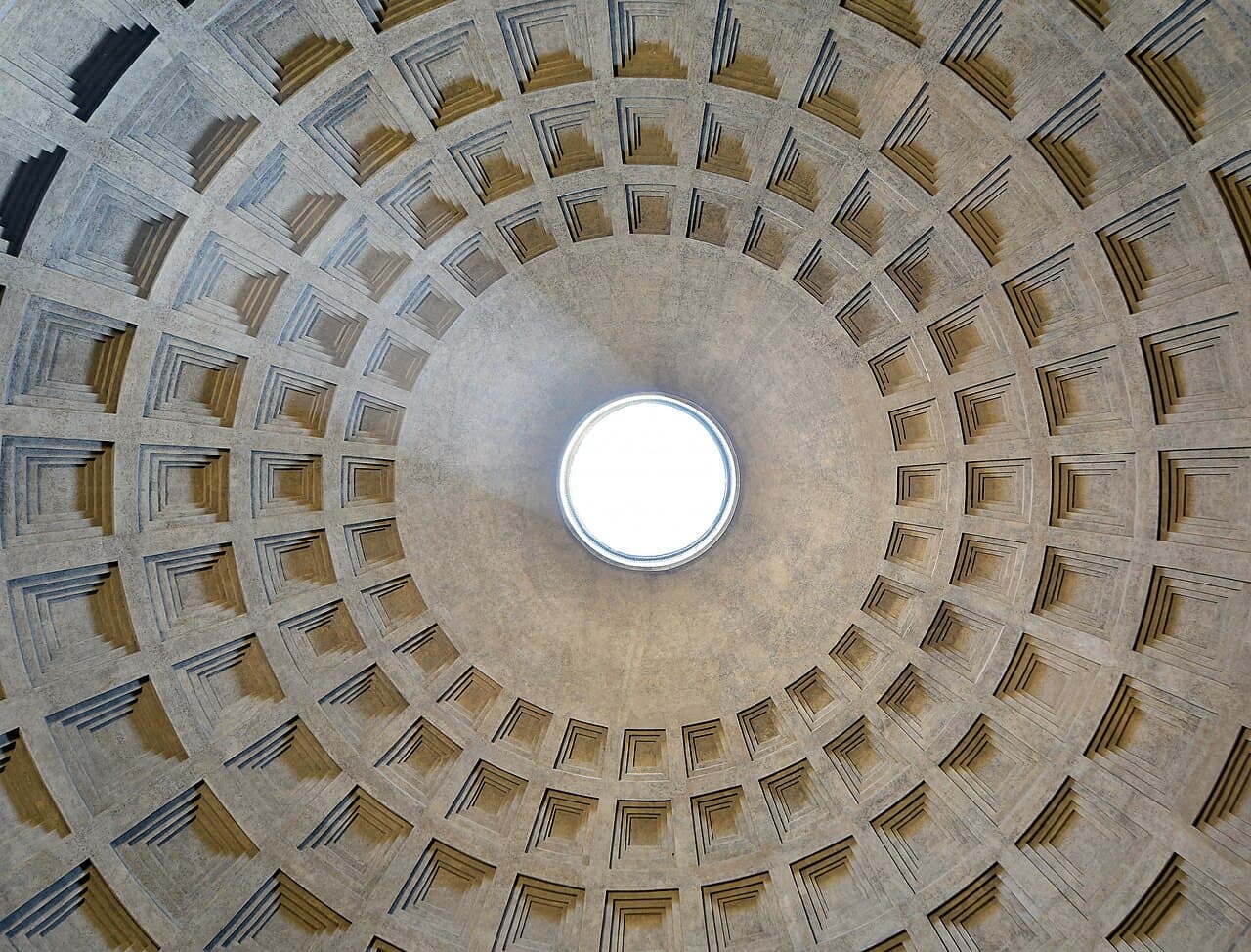
Almost 2,000 years after a Roman emperor rebuilt the Pantheon, its dome is still the largest unreinforced concrete dome on Earth.
▶ Start the storyRome's most lasting architectural trick wasn't a design, it was a material. From the 3rd century BC, Roman builders used concrete, a mix of lime mortar, volcanic ash, water, and stone that turned out stronger than anything used before it. That single invention, sometimes called the "concrete revolution," let architects escape the limits of stacking stone and finally exploit the arch, the vault, and the dome at scale, building amphitheatres, aqueducts, baths, bridges, and temples across an entire empire. The architectural historian Gottfried Semper called the result simply "the idea of world domination expressed in stone."
The clearest proof is still standing in Rome. Under Emperor Hadrian, in what many consider Roman architecture's peak, the Pantheon was rebuilt into its current form, crowned with a concrete dome 43 metres across. Almost two thousand years later, it is still the world's largest unreinforced concrete dome, and Roman domes in general stayed unsurpassed in size until structural steel frames arrived in the late 19th century. The same concrete that made the Pantheon possible also kept aqueducts and bridges standing long after Rome fell: the Roman bridge at Mérida, in Spain, is still carrying daily traffic today.
It wasn't just about raw strength, either. Augustus famously boasted that he found Rome a city of brick and left it a city of marble, though in truth that marble was mainly a facing over plain brick and concrete underneath, a very Roman combination of genuine engineering and calculated showmanship.
Quiz me
0/3
Recap
Roman concrete, first used at Cosa after 273 BC, enabled domes, aqueducts, and bridges so durable that some, like the bridge at Mérida, are still used daily today.
Surprising fact · Almost 2,000 years on, Hadrian's Pantheon still has the world's largest unreinforced concrete dome.
Connects to
Sources (2)
No source, no claim. Every fact in this lesson (12 claims) cites at least one of these.