How did a piece of paper become as good as gold?
A thousand coins are heavy and slow to count. A note promising to pay a thousand coins on demand is light, fast — and only works if everyone trusts the promise.
▶ Start the storyIt began as a receipt. A banknote was a promise: the bank would pay the bearer a fixed amount of coin, whenever asked. As long as people trusted that promise, the paper was as good as the metal behind it.
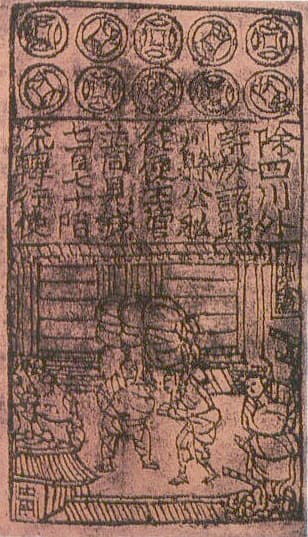
The first paper money in history is jiaozi, from Chengdu in China, around the 11th century. A private merchant enterprise issued it to replace the heavy iron coins then in use. In 1023, after several merchant issuers went bankrupt, the Song government took over. Each note carried several official seals to stop forgers. But the government didn't back its notes with enough coins, and they lost value.
In Europe, the Bank of Scotland was the first bank to successfully print its own notes, in 1696. Like early banknotes elsewhere, they could be swapped for gold or silver coin at the bank. A note was far lighter than a bag of coins, as long as the bank kept enough metal to honour it.
Coin
- Value checked by weight and purity
- Heavy to carry in bulk
- Carries its value in its own metal
Banknote
- Value backed by a promise to pay
- Light and fast to count
- Loses value if too little coin backs it
That link didn't last. Today most national currencies have no backing in gold, silver or anything else. A modern banknote is worth something because the law says so and because everyone trusts that others will accept it. Economists call this fiat money.
Quiz me
0/3
Recap
A banknote is a promise to pay; when the promise is backed by too little, the paper loses value.
Surprising fact · China's jiaozi, the first paper money, lost value because the Song government didn't back it with enough coins.
Sources (2)
No source, no claim. Every fact in this lesson (13 claims) cites at least one of these.