Why does a positive result from a 99% accurate test often mean so little?
A test that is right 99% of the time can still be wrong about most of the people it flags.
▶ Start the storyBecause how likely you are to be sick depends not only on the test, but on how rare the illness was to begin with. Bayes' theorem is the rule that combines the two. It turns "how often is the test positive when someone is sick?" into the question you actually care about: "how likely am I to be sick, given that my test is positive?"
Take a disease that 1% of people have and a test that gives the right answer 99% of the time. After a positive result, your chance of being ill is not 99%. It is 50%. The reason is that the healthy crowd is so much bigger: 1% of a huge number of healthy people produces about as many false alarms as the test finds real cases.
The cleanest way to run the rule is with odds. The posterior odds are the prior odds times the likelihood ratio, sometimes called the Bayes factor. Before the test, the odds were 1 to 99. The test is 99 times more likely to say "positive" for a sick person than a healthy one, so the odds become 99 to 99, or one to one.
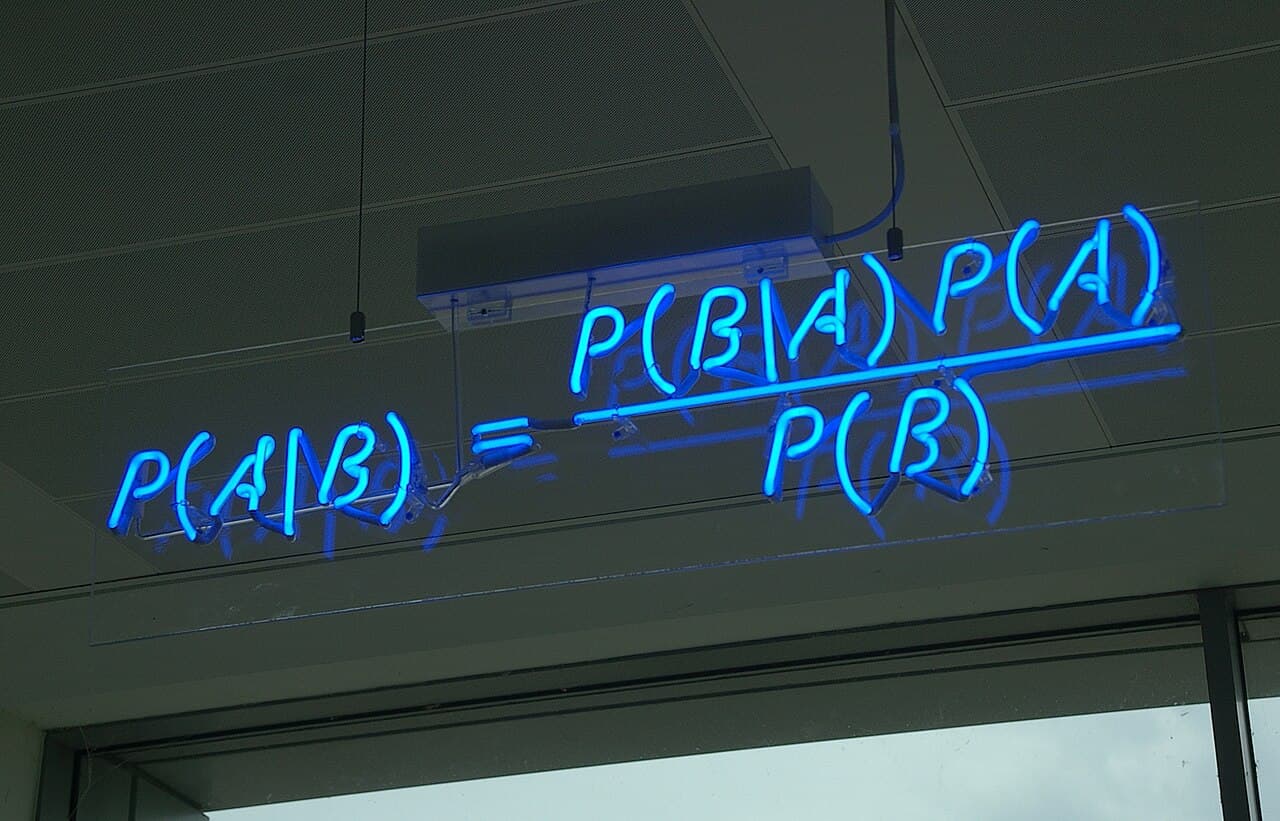
The rule is named after Thomas Bayes, an English Presbyterian minister who never published it. After he died in 1761, his friend Richard Price edited his notes and had them read at the Royal Society in 1763. Two and a half centuries later, the same arithmetic tells doctors and juries how much a piece of evidence should really move them: a blood match shared by 10% of a town of 1,000 points to 100 people, so on its own it gives a 1% chance of guilt, not 90%.
Quiz me
0/3
Recap
New odds = old odds × how much more likely the evidence is if you're right than if you're wrong.
Surprising fact · Thomas Bayes never published his theorem: a friend found it in his papers and had it read at the Royal Society two years after his death.
Sources (3)
No source, no claim. Every fact in this lesson (17 claims) cites at least one of these.