How did a Dutch cloth merchant discover an entire invisible universe?
He only wanted to inspect thread quality more closely. Instead he became the first person to watch living microbes.
▶ Start the storyAntonie van Leeuwenhoek was largely self-taught in science. He was a cloth merchant in the Dutch city of Delft, and what drove him toward the microscope wasn't curiosity about life, but business: he wanted to judge the quality of his thread more closely than the weak magnifying lenses of his day allowed. Teaching himself a method of melting and pulling glass rods into tiny, high-quality lenses, he built single-lensed microscopes of his own design, first of all to examine thread.
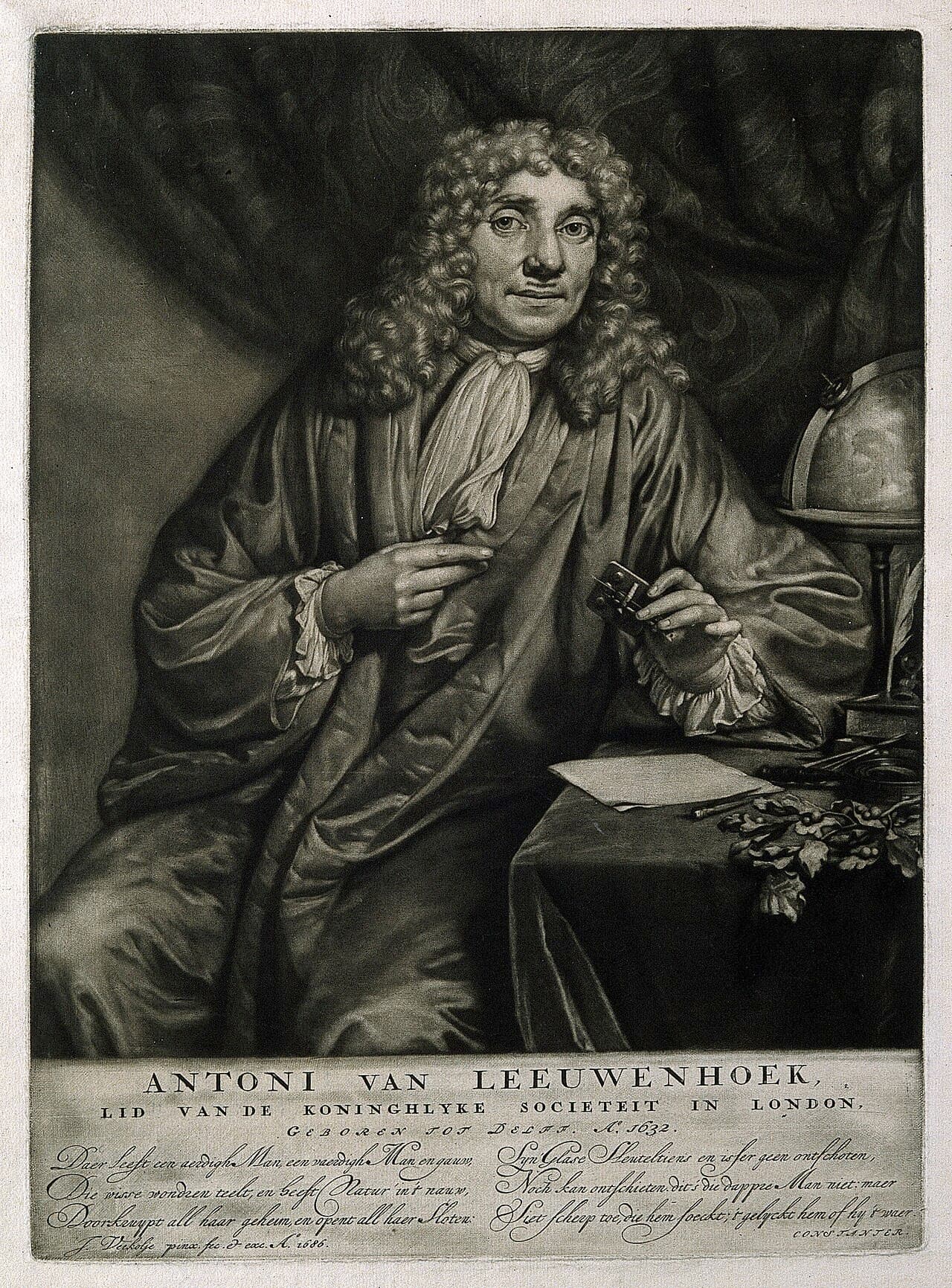
Then, in 1674, he turned that lens on something other than cloth, and the thread business became a footnote. Watching movement under his microscope, he reasoned that if something moved on its own, it must be alive, and concluded that the tiny moving specks he was seeing were, in his words, dierkens, 'little animals.' He had just become the first person in history to see single-celled life, though he had no idea yet how enormous that discovery was.
Van Leeuwenhoek never published a scientific paper and never wrote in Latin, the language of science at the time. Instead he sent chaotic letters, written in his own everyday Dutch, to the Royal Society in London, where Henry Oldenburg learned Dutch just to translate them. When Van Leeuwenhoek described, in 1676, creatures too small for anyone else to have ever seen, the Society doubted him, since nobody had known single-celled organisms existed at all. By the time he died in 1723, he had sent the Society roughly 190 letters, and today he is remembered as the Father of Microbiology.
Quiz me
0/3
Recap
A merchant who only wanted to check his thread more closely ended up being the first person to observe microbes.
Surprising fact · His first report of single-celled organisms, in 1676, was met with skepticism because nobody yet knew such tiny living things existed.
Sources (1)
No source, no claim. Every fact in this lesson (8 claims) cites at least one of these.